

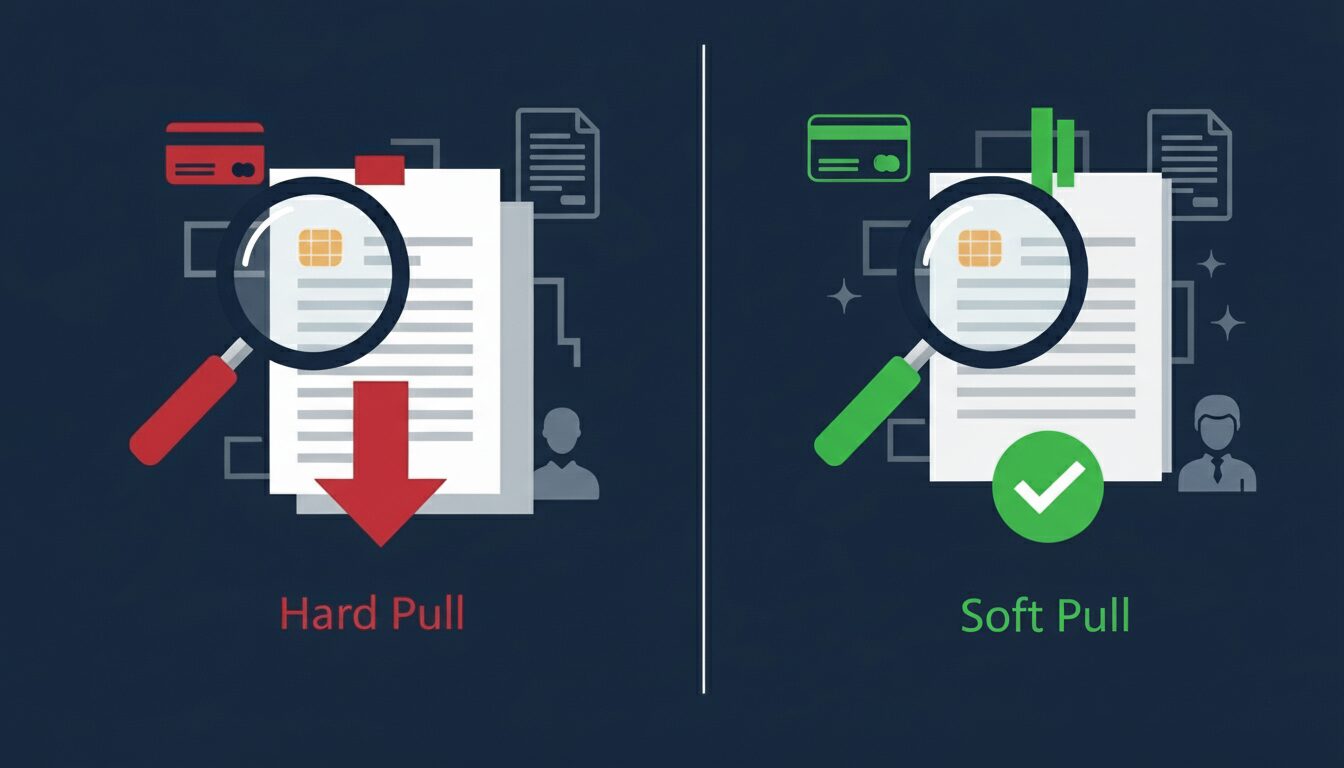
Every time someone checks your credit, it leaves a mark — but not all marks are created equal. If you’ve ever applied for a credit card and noticed your score dip a few points, you’ve experienced a hard inquiry firsthand. But when you check your own credit score on an app, nothing happens. Why?
Understanding the difference between a hard inquiry vs. soft inquiry on your credit report is one of the most practical things you can do to protect your score. Whether you’re shopping for a mortgage, comparing credit cards, or just keeping tabs on your financial health, knowing which type of check is happening — and what it means — puts you firmly in control.
What Is a Hard Inquiry?
A hard inquiry (also called a hard pull) occurs when a lender or creditor checks your credit report as part of a formal application for credit. This happens when you apply for:
- A new credit card
- A personal loan or auto loan
- A mortgage
- A student loan
- An apartment rental (in many cases)
- A new cell phone plan with financing
Hard inquiries require your explicit authorization. When you sign a credit application, you’re giving the lender permission to pull your full credit report from one or more of the three major bureaus — Experian, Equifax, or TransUnion.
How Much Does a Hard Inquiry Affect Your Credit Score?
According to myFICO, a single hard inquiry typically lowers your FICO score by less than 5 points. That’s a small dent — but multiple hard inquiries in a short period can add up and signal risk to lenders.
Hard inquiries stay on your credit report for two years, but their impact on your score fades significantly after the first 12 months.
When Multiple Hard Inquiries Count as One
The credit scoring models are smart about rate shopping. If you’re comparing rates for a mortgage, auto loan, or student loan, multiple inquiries made within a 14–45 day window (depending on the scoring model) are typically grouped and counted as a single inquiry.
This rate-shopping protection does not apply to credit card applications — each card application counts as a separate hard pull.
What Is a Soft Inquiry?
A soft inquiry (also called a soft pull) occurs when your credit is checked in a way that does not affect your credit score — period. Soft inquiries happen when:
- You check your own credit score or report
- A credit card company pre-screens you for a pre-approved offer
- An employer runs a background check
- A landlord does a preliminary screening
- A bank checks your credit to verify your identity
- You use a credit monitoring service
The key difference: soft inquiries do not require your permission and do not impact your score. They appear on your credit report in a section that only you can see — lenders cannot see your soft inquiry history.
Why Soft Inquiries Don’t Hurt Your Credit
Soft inquiries don’t indicate that you’re actively seeking new debt. A pre-approval check from Capital One or those “You may be pre-qualified” mailers are soft pulls — the company is marketing to you, not underwriting you. Because there’s no credit risk signal, the bureaus don’t factor them into your score.
Hard Inquiry vs. Soft Inquiry: Side-by-Side Comparison
| Feature | Hard Inquiry | Soft Inquiry |
|---|---|---|
| Affects credit score? | ✅ Yes (slightly) | ❌ No |
| Requires your permission? | ✅ Yes | ❌ Not always |
| Visible to lenders? | ✅ Yes | ❌ No (only you can see) |
| How long on report? | 2 years | Varies (often 1–2 years) |
| Common triggers | Loan/card applications | Pre-approvals, self-checks |
| Can be disputed? | ✅ Yes, if unauthorized | ✅ Yes |
Why It Matters for Your Credit Score
Your credit score is built on five key factors. Hard inquiries fall under the “New Credit” category, which accounts for 10% of your FICO score. It’s the smallest category, which is why a single hard pull rarely causes serious damage.
However, context matters. If a lender sees five hard inquiries on your report in two months, they may interpret that as a sign of financial stress — that you’ve been rejected multiple times or are desperately seeking credit. This perception can hurt your approval odds even beyond the raw point deductions.
The Consumer Financial Protection Bureau (CFPB) recommends reviewing your credit report regularly to ensure all inquiries listed are ones you actually authorized.
How to Check for Unauthorized Hard Inquiries

Unauthorized hard inquiries — ones you didn’t approve — can be a sign of identity theft or a creditor error. Here’s how to handle them:
Step 1: Pull Your Free Credit Reports
Visit AnnualCreditReport.com to access your free reports from all three bureaus. You’re entitled to free weekly reports under current federal law.
Step 2: Identify Any Unfamiliar Inquiries
Review the “Inquiries” section of each report. If you see a hard pull from a lender you never applied to, flag it immediately.
Step 3: Dispute the Inquiry
Contact the credit bureau directly to file a dispute. You can do this online through:
- Experian’s Dispute Center
- Equifax Dispute Portal
- TransUnion Dispute Portal
Each bureau is required to investigate your dispute within 30 days under the Fair Credit Reporting Act (FCRA).
Step 4: Monitor Your Credit Ongoing
One unauthorized inquiry might be a mistake. Multiple unauthorized inquiries is a red flag for identity theft. If you’re seeing suspicious activity, setting up a credit freeze at all three bureaus is the most effective protection available.
💡 Related: Staying on top of your inquiries is much easier with the right tools. Check out our guide to the Best Credit Monitoring Services in the USA (2026) — Top 5 Compared to find a service that alerts you in real time whenever a hard pull hits your report.
Best Tips to Minimize the Impact of Hard Inquiries
✅ Batch Your Credit Applications
If you need multiple credit products, apply for them within a short window. For rate-sensitive products like mortgages or auto loans, use the 14–45 day shopping window to compare lenders without stacking up score damage.
✅ Only Apply for Credit You Actually Need
Each credit card application triggers a hard pull. Don’t apply for store cards at checkout just to get a 10% discount — the small savings rarely outweigh the inquiry and the temptation to carry a balance.
✅ Use Pre-Qualification Tools First
Most major credit card issuers — including Chase, American Express, and Capital One — offer pre-qualification or pre-approval tools on their websites. These use soft inquiries to estimate your approval odds without touching your score.
✅ Space Out Applications
If possible, avoid applying for multiple credit cards within a 6-month period. Lenders are particularly sensitive to recent application activity.
✅ Check Your Own Credit Freely
Checking your own credit is always a soft inquiry. There’s no penalty for monitoring your score daily. In fact, proactive monitoring is one of the smartest financial habits you can build.
Common Mistakes to Avoid
- Applying for multiple credit cards at once to earn welcome bonuses. Each application is a hard pull, and issuers share inquiry data — multiple applications in a short period can trigger automatic denials.
- Thinking a denied application doesn’t leave a hard inquiry. It does. Even if you’re rejected, the hard pull stays on your report for two years.
- Ignoring unfamiliar inquiries. A hard pull you don’t recognize is worth investigating immediately.
- Confusing pre-approval mailers with actual approvals. Those “You’re pre-approved!” offers are based on soft pulls. The actual application still triggers a hard inquiry.
- Applying for new credit right before a major loan. Opening new accounts or accumulating inquiries before a mortgage application can spook lenders and temporarily lower your score at the worst possible time.
💡 Also worth reading: If you’re reconsidering which credit cards are actually worth keeping, you’ll want to read our article on why Amazon is about to make millions of Americans realize they have the wrong credit card — and what to do about it.
Expert Tips to Get Better Results

Know Your Score Before You Apply
Before submitting any credit application, know roughly where your score stands. Most banks offer free FICO score access to existing customers. Knowing your score helps you target cards and loans you’re likely to qualify for — reducing the chance of a wasted hard pull.
Freeze Your Credit When Not Actively Borrowing
A credit freeze (also called a security freeze) is free and blocks all hard inquiries until you lift it. If you’re not planning to apply for credit in the near future, freezing your reports at all three bureaus is one of the best protections against unauthorized pulls and identity theft.
Understand the Difference Between FICO Versions
Different lenders use different FICO versions — and some use VantageScore. The impact of hard inquiries can vary slightly between models. Mortgage lenders typically use older FICO versions (FICO 2, 4, and 5), while credit card issuers often use FICO 8 or FICO 9.
Keep the Rest of Your Profile Strong
Even if you have several recent hard inquiries, a strong credit profile — on-time payments, low utilization, long credit history — will absorb the impact. Hard inquiries are the least influential factor in your score. Focus most of your energy on payment history (35%) and credit utilization (30%).
Frequently Asked Questions (FAQ)
How many points does a hard inquiry take off your credit score?
A single hard inquiry typically reduces your FICO score by fewer than 5 points. The exact impact depends on your overall credit profile. If you have a thin credit history or a lower score, the impact may be slightly higher.
How long do hard inquiries stay on your credit report?
Hard inquiries remain on your credit report for two years. However, they only affect your FICO score for 12 months. After the first year, the inquiry is still visible on your report but no longer counted in your score calculation.
Can I remove a hard inquiry from my credit report?
You can dispute and remove a hard inquiry if it was made without your authorization. Legitimate hard inquiries — ones you authorized by applying for credit — cannot be removed before the two-year mark, even if you were denied.
Does checking my own credit score hurt it?
No. Checking your own credit score or pulling your own credit report is always a soft inquiry and has zero impact on your credit score, regardless of how often you do it.
Do pre-approved credit card offers hurt my credit?
No. Pre-approved and pre-qualified offers are based on soft inquiries. Your credit score is only affected when you formally respond and submit a full application, which triggers a hard pull.
Final Thoughts
The distinction between a hard inquiry vs. soft inquiry is simple once you understand the logic: a hard pull signals you’re actively seeking new credit, while a soft pull is just a background check or informational review. Hard inquiries have a small, temporary impact — but managed carelessly, they can add up.
The smartest approach is to apply for credit deliberately, use pre-qualification tools whenever available, and keep a close eye on your credit report for any inquiries you didn’t authorize.
Your credit score is one of your most valuable financial assets. The more you understand how it works, the better equipped you are to protect and grow it.
For more in-depth guides on credit cards, credit scores, and building financial confidence in the U.S., explore everything we have at CreditPilotUSA.com — we’re here to help you navigate every step of your credit journey.
Disclaimer: This article is for informational purposes only and does not constitute financial or legal advice. Always consult with a qualified financial professional before making major financial decisions.

Danilo is a Credit Analyst and the Founder of CreditPilotUSA.com. With deep expertise in the credit card industry, he translates complex banking news and reward systems into actionable financial strategies. Dedicated to helping Americans master their credit scores and maximize the cards in their wallets.