
Advertiser Disclosure: We earn compensation when you apply for cards through our links. This never influences our ratings. Read our editorial policy →
Quick Answer
The best student credit card of 2026 is the Discover it® Student Cash Back — it earns 5% on rotating categories, charges no annual fee, and matches all cash back in year one. For a simple flat-rate option, the Bank of America® Travel Rewards for Students earns 1.5x points on everything with no annual fee and no foreign transaction fees. For students who want to graduate to premium rewards fast, the Chase Freedom Rise℠ offers a clear upgrade path into the Chase ecosystem.
By Danilo Souza | Last reviewed: June 17, 2026
Why Your First Credit Card Decision Matters More Than You Think
The credit card you open as a student does not just give you a way to pay for textbooks and coffee — it starts a financial record that lenders, landlords, and even some employers will check for years. A first card opened at 19 and managed well can mean a 720+ credit score by 22, which translates to lower interest rates on car loans, easier apartment approvals, and access to premium rewards cards before your peers.
The risk is equally real. One missed payment at 20 stays on your credit report until you are 27. High utilization during finals week can drop your score 40–60 points overnight.
Student credit cards are designed specifically for this moment — lower approval barriers, lower limits, and guardrails that make the learning curve less dangerous. Here is how to pick the right one.
What Makes a Student Card Different From a Regular Card
Lower credit score requirements: Most student cards accept applicants with no credit history at all — they evaluate enrollment status, income (including part-time jobs and financial aid), and sometimes a co-signer option.
Lower credit limits: Starting limits of $500–$1,000 are standard. This limits damage from overspending while you develop habits.
No annual fee: Every student card worth considering charges zero annual fee. There is no reason to pay a fee for your first card — the best no annual fee cards of 2026 all beat student cards on rewards once your score is established.
Graduation path: The best student cards automatically review your account and upgrade you to a standard card after 12–24 months of responsible use — returning your account history intact.
Our Methodology
Danilo Souza evaluated 14 student credit cards available to US college students as of June 2026. Cards were scored on approval accessibility (30%), credit-building mechanics (25%), rewards structure (25%), and graduation path clarity (20%). No card paid to be included.
Jump to a Card
| Card | Best For | |
|---|---|---|
| #1 | Discover it® Student Cash Back | Rotating 5% categories + year-one match |
| #2 | Chase Freedom Rise℠ | Chase ecosystem entry point |
| #3 | BofA Travel Rewards for Students | Flat-rate points, no foreign transaction fee |
| #4 | Capital One Quicksilver Student | Simple 1.5% flat cash back |
| #5 | Citi Rewards+® Student Card | Rounded-up points on every purchase |
The 5 Best Student Credit Cards of 2026
1. Discover it® Student Cash Back — Best Overall
| Detail | Value |
|---|---|
| Annual fee | $0 |
| Welcome bonus | Cashback Match — all year-one cash back doubled |
| Earning rate | 5% rotating quarterly categories (up to $1,500/quarter), 1% everything else |
| Intro APR | 0% for 6 months on purchases |
| Regular APR | 18.24%–27.24% variable |
| Credit score needed | No credit history required |
| Foreign transaction fee | None |
| Graduation path | Auto-review for upgrade to standard Discover it |
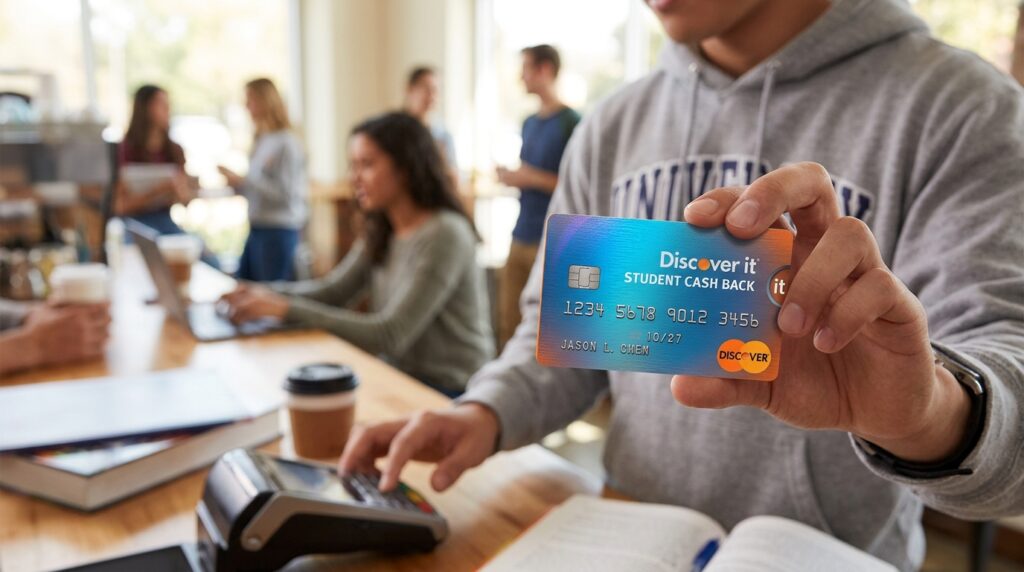
Why it ranks first: The Discover it Student Cash Back is the only student card that earns meaningful rewards while simultaneously offering the easiest approval for applicants with zero credit history. The Cashback Match in year one doubles every dollar earned — a student spending $800/month who earns $180 in cash back receives an additional $180 at year-end, totaling $360 from a card with no annual fee and no credit history required.
The good-grades bonus: Discover offers a $20 statement credit each school year your GPA is 3.0 or above, for up to five years. Small but automatic — another reason this card is designed specifically for students.
Activation reminder: The 5% rotating categories require quarterly activation through the Discover app. Historical categories have included Amazon, grocery stores, restaurants, and gas stations. Set a reminder for the first of each quarter.
Best for: First-time cardholders with no credit history who want real rewards from day one and the longest possible first-year bonus.
2. Chase Freedom Rise℠ — Best for Chase Ecosystem Entry
| Detail | Value |
|---|---|
| Annual fee | $0 |
| Welcome bonus | $25 statement credit after enrolling in autopay |
| Earning rate | 1.5% cash back on all purchases |
| Regular APR | 26.99% variable |
| Credit score needed | No credit history required (Chase Savings account helps approval odds) |
| Foreign transaction fee | 3% |
| Graduation path | Upgrade to Chase Freedom Unlimited® or Freedom Flex® after 12 months |
Why it ranks second: The Chase Freedom Rise earns 1.5% on everything with no annual fee and no credit history required — but its real value is strategic. After 12 months of responsible use, Chase proactively reviews your account for an upgrade to the Chase Freedom Unlimited, which earns 1.5% base plus 3% on dining and drugstores, and whose points can eventually be pooled with a Sapphire card for premium travel redemptions. Opening this card at 19 is step one of a multi-year rewards strategy.
Approval tip: Having a Chase checking or savings account with at least $250 before applying significantly increases approval odds, according to reported applicant data. If you do not have a Chase account, consider opening one first.
Best for: Students who plan to stay in the Chase ecosystem long-term and want their first card to feed into a future Sapphire or Ink card strategy.
3. Bank of America® Travel Rewards Credit Card for Students — Best for International Students
| Detail | Value |
|---|---|
| Annual fee | $0 |
| Welcome bonus | 25,000 points after $1,000 spend in 90 days (worth $250 in travel) |
| Earning rate | 1.5x points on all purchases |
| Regular APR | 19.24%–29.24% variable |
| Credit score needed | Limited credit history acceptable |
| Foreign transaction fee | None |
| Graduation path | Standard BofA travel cards |
Why it ranks third: The absence of a foreign transaction fee makes this the best student card for international students or domestic students who travel or study abroad. Most student cards charge 3% on international purchases — on $2,000 in semester-abroad spending, that is $60 in invisible fees. The 25,000-point welcome bonus worth $250 in travel statement credits is also the highest monetary value welcome bonus of any student card on this list.
Best for: International students. Domestic students planning to study abroad or travel during breaks. Students who want travel-redeemable points from their first card.
4. Capital One Quicksilver Student Cash Rewards — Best Simple Flat Rate
| Detail | Value |
|---|---|
| Annual fee | $0 |
| Welcome bonus | $50 after $100 spend in 3 months |
| Earning rate | 1.5% cash back on all purchases, 10% on Capital One Travel hotels and rental cars |
| Regular APR | 19.99%–29.99% variable |
| Credit score needed | No credit history required |
| Foreign transaction fee | None |
| Graduation path | Auto-review for upgrade after 6 months |
Why it ranks fourth: The Capital One Quicksilver Student is the simplest card on this list — 1.5% on everything, no categories, no activation, no tracking. The $50 welcome bonus requires only $100 in spend, making it the most accessible welcome bonus of any card here. Capital One also begins reviewing for upgrade to the standard Quicksilver card after just six months — the fastest graduation timeline on this list.
Best for: Students who want absolute simplicity and the fastest possible path to a standard card. Anyone who finds category tracking stressful.
5. Citi Rewards+® Student Card — Best for Small Everyday Purchases

| Detail | Value |
|---|---|
| Annual fee | $0 |
| Welcome bonus | 2,500 ThankYou points after $500 spend in 3 months |
| Earning rate | 2x at supermarkets and gas stations (up to $6,000/year), 1x everything else — rounded up to nearest 10 points on every purchase |
| Regular APR | 18.74%–28.74% variable |
| Credit score needed | Limited credit history acceptable |
| Foreign transaction fee | None |
| Graduation path | Standard Citi Rewards+ card |
Why it ranks fifth: The rounding feature is unique — every purchase earns points rounded up to the nearest 10. A $1 coffee earns 10 points instead of 1. A $23 Uber earns 30 points instead of 23. For students making frequent small purchases — coffee, convenience stores, vending machines — this rounding adds meaningful value that no other student card offers. The 2x at supermarkets is also one of the stronger grocery rates among student cards.
Best for: Students who make frequent small purchases and want every transaction to feel rewarding. Grocery-heavy spenders who cook at home on a student budget.
Student Credit Card Comparison Table
| Card | Annual Fee | Earning Rate | No Credit History | Foreign Fee | Upgrade Path |
|---|---|---|---|---|---|
| Discover it® Student | $0 | 5% rotating / 1% | Yes | None | Auto review |
| Chase Freedom Rise℠ | $0 | 1.5% flat | Yes | 3% | 12 months |
| BofA Travel Student | $0 | 1.5x flat | Limited OK | None | Standard BofA |
| Capital One Quicksilver Student | $0 | 1.5% flat | Yes | None | 6 months |
| Citi Rewards+® Student | $0 | 2x grocery / 1x + rounding | Limited OK | None | Standard Citi |
The 3 Rules for Your First Credit Card
Rule 1 — Pay the full balance every month, without exception. Set up autopay for the full statement balance the day you get the card. Not the minimum payment — the full balance. This eliminates interest charges entirely and builds a perfect payment history automatically.
Rule 2 — Keep utilization below 10% of your limit. On a $500 limit, that means no more than $50 showing on your statement at the end of the billing cycle. Pay mid-cycle if needed to keep the reported balance low. Utilization is the fastest-moving factor in your credit score — getting this right can add 30–50 points within two billing cycles.
Rule 3 — Do not apply for more than one card in your first year. Every application triggers a hard inquiry. Give your first card 12 months to age, build payment history, and improve your score before opening a second account. If you want a second card after year one, you will likely qualify for the best no annual fee cards or even entry-level rewards cards by then.
Frequently Asked Questions
Can I get a student credit card with no income?
Most student cards consider financial aid, scholarships, and part-time income as qualifying income. You do not need a traditional full-time job. Some issuers also allow a co-signer — typically a parent or guardian — whose income is considered in the application. Discover and Capital One are the most flexible on income requirements for student applicants.
What credit score do I need for a student credit card?
Most student cards on this list accept applicants with no credit history at all — you do not need an existing credit score. Issuers evaluate enrollment status, income, and overall financial profile instead. If you have been rejected for a student card, a secured card is the next step — see our guide to the best credit cards for bad credit and no credit →.
Should I get a student card or a secured card?
If you qualify for a student card, choose the student card — they typically have no annual fee, no deposit requirement, and a clearer graduation path than secured cards. Student cards are designed for exactly your situation. Secured cards are the right fallback if you have been rejected by student card issuers or if you are not currently enrolled in an accredited institution.
How long should I keep my student credit card?
Keep it open indefinitely if it has no annual fee. Closing your oldest card shortens your average account age and reduces your total available credit — both of which can lower your score. When you graduate and qualify for better cards, simply add new cards without closing the student card. Let it age in your wallet as a long-term positive account.
The Bottom Line
The best student credit card in 2026 is the one you will use responsibly — but among the options:
- Best overall: Discover it® Student — year-one match, real rewards, no history required.
- Best strategy: Chase Freedom Rise℠ — entry point to the Chase ecosystem with a clear upgrade path.
- Best for travel / international: BofA Travel Rewards Student — no foreign transaction fee, strong welcome bonus.
- Simplest: Capital One Quicksilver Student — 1.5% flat, fastest graduation at 6 months.
- Best for small purchases: Citi Rewards+® Student — rounding makes every transaction count more.
Keep building:
- Best credit cards for bad credit →
- Best no annual fee credit cards →
- Back to: Best credit cards of 2026 →
Last updated: June 17, 2026. Verify all current offers on each issuer’s website before applying. Danilo Souza is a personal finance writer with no paid relationships with any issuer reviewed here.

Danilo is a Credit Analyst and the Founder of CreditPilotUSA.com. With deep expertise in the credit card industry, he translates complex banking news and reward systems into actionable financial strategies. Dedicated to helping Americans master their credit scores and maximize the cards in their wallets.