
If you fly at least twice a year, stay in hotels, or spend money on dining and groceries, you are leaving hundreds — possibly thousands — of dollars in free travel on the table every year.
The best travel Credit cards in the USA don’t just earn points. They turn everyday American spending into flights, hotel nights, and upgrades that would otherwise cost real money. And in 2026, the competition between issuers has pushed welcome bonuses, transfer partner networks, and category earn rates to some of the highest levels ever seen.
This guide breaks down the best travel Credit cards in the USA for points and miles — from entry-level options with no annual fee to premium cards that pay for themselves many times over — with real dollar value estimates, honest tradeoffs, and a clear recommendation for every type of traveler.
Editorial note: CreditPilotUSA.com evaluates credit cards based on annual rewards value, fee structure, and real cardholder data. Cards are selected independently — we are not paid to feature specific products.
Last updated: March 2026
Quick Answer
The best travel credit cards in the USA for most travelers are the Chase Sapphire Preferred® ($95/year, 60,000-point bonus, 3x dining) for beginners to intermediate travelers, the American Express Gold Card ($250/year, 4x dining and groceries) for food-heavy spenders, and the Capital One Venture Rewards ($95/year, 2x everywhere) for flat-rate simplicity. Premium travelers should look at the Chase Sapphire Reserve® or Amex Platinum for lounge access and travel credits.
How Travel Credit Card Points Actually Work
Before comparing cards, understanding what points are actually worth changes everything about how you evaluate them.
The three redemption tiers — and why they’re not equal:
| Redemption Method | Value Per Point | Example |
|---|---|---|
| Statement credit | 0.5–1¢ | Worst value — avoid |
| Portal booking (Chase, Amex, Capital One Travel) | 1–1.25¢ | Convenient but not optimized |
| Transfer to airline / hotel partner | 1.5–3¢+ | Best value — where the real returns are |
A 60,000-point Chase welcome bonus is worth $750 if booked through Chase Travel. The same 60,000 points transferred to United Airlines and used for a business class flight to Europe can be worth $2,400–$3,600.
The gap between average and optimized redemption is not marginal — it’s often 3–4x. Every card in this guide has transfer partners. Learning to use one transfer program is the single highest-leverage action a travel card holder can take.
Best Travel Credit Cards in the USA for 2026
🥇 Chase Sapphire Preferred® — Best First Travel Card

The Chase Sapphire Preferred has been the most-recommended entry-level travel card in the US for years — and in 2026, it still earns that position.
Key specs:
| Detail | Value |
|---|---|
| Annual Fee | $95 |
| Welcome Bonus | 60,000 points after $4,000 spend in 3 months |
| Dining & Online Grocery | 3x points |
| Streaming Services | 3x points |
| Travel | 2x points |
| All Other Purchases | 1x |
| Transfer Partners | 14 airlines and hotels (1:1) |
| Point Value (portal) | 1.25¢ each |
| Foreign Transaction Fee | None |
| Trip Cancellation Insurance | Up to $10,000/trip |
| Primary Rental Car Coverage | ✅ Yes |
Welcome bonus value: 60,000 points = $750 via Chase Travel or up to $1,200+ via airline transfers.
Why it wins for beginners: The $95 fee is genuinely easy to justify. The 3x on dining and streaming alone covers the fee for most US households. And the 14 transfer partners — including United Airlines, Southwest, Hyatt, British Airways, and Air France/KLM — give cardholders a clear path to premium travel redemptions when they’re ready.
The best transfer partner most people miss: World of Hyatt. Transferring 25,000 Chase points to Hyatt can book a Category 4 hotel at $200–$300/night for free. For hotel travelers, this single transfer unlocks extraordinary value.
Best for: First-time travel card holders, households spending $400+/month on dining, anyone who wants a clear upgrade path to premium redemptions.
Annual fee verdict: The $50 annual hotel credit (through Chase Travel) alone effectively reduces the fee to $45/year. At $45 net, this is one of the best-value cards in the market.
🥈 American Express Gold Card — Best for Dining + Travel Combination

For households where food is the dominant spending category, the Amex Gold is the most efficient earning machine available at its price point. No travel card earns more on dining and groceries than 4x — and the Amex Gold does both.
Key specs:
| Detail | Value |
|---|---|
| Annual Fee | $250 |
| Effective Annual Fee | ~$10 (after credits) |
| Restaurants Worldwide | 4x points |
| US Supermarkets | 4x points (up to $25,000/year) |
| Flights (direct or Amex Travel) | 3x points |
| All Other Purchases | 1x |
| Annual Dining Credit | $120 ($10/month at Grubhub/partners) |
| Annual Uber Cash | $120 ($10/month) |
| Dunkin’ Credit | $84/year |
| Resy Credit | $100/year |
| Transfer Partners | 21 airlines and hotels |
| Foreign Transaction Fee | None |
Why it makes this list: At ~$10 effective annual fee after credits, the Amex Gold offers a 4x earning rate on the two categories most Americans spend the most on. Combined with 21 transfer partners — the largest ecosystem in the market — and a 60,000-point welcome bonus, it’s the strongest card available for food-forward spenders who want premium travel redemptions.
The transfer partner most Amex cardholders don’t use: ANA Mileage Club. Transferring 88,000 Amex points to ANA books a round-trip business class flight from the US to Japan — tickets that retail for $6,000–$8,000. One trip. One transfer. Fully covered.
For the complete breakdown of credits and annual value, see our American Express Gold Card review.
Best for: Households spending $500+/month combined on dining and groceries who use Uber or Grubhub regularly and want access to a premium transfer partner network.
🥉 Capital One Venture Rewards — Best Flat-Rate Travel Card

The Capital One Venture solves the problem most travel cards create: complexity. While other cards require quarterly activation, category management, and portal navigation, the Venture earns 2x miles on everything and lets you erase any travel purchase from your statement — any airline, any hotel, any Airbnb, any Uber to the airport.
Key specs:
| Detail | Value |
|---|---|
| Annual Fee | $95 |
| Welcome Bonus | 75,000 miles after $4,000 spend in 3 months |
| Every Purchase | 2x miles |
| Hotels + Rental Cars (via Capital One Travel) | 5x miles |
| Global Entry / TSA PreCheck Credit | $100 (every 4 years) |
| Transfer Partners | 15+ airlines and hotels |
| Foreign Transaction Fee | None |
| Redemption Flexibility | Any travel purchase, no portal required |
Why it stands out: The $100 Global Entry credit nearly covers the $95 annual fee by itself. The 75,000-point welcome bonus is worth $750 in flexible travel — and with transfers to Turkish Airlines Miles&Smiles (one of the best-value Star Alliance programs), sophisticated travelers can extract $1,500–$2,000 in premium cabin value from the same points.
For the full cost-benefit analysis, see our Capital One Venture Rewards review.
Best for: Travelers who want consistent rewards on all spending without category management, and anyone who books travel outside traditional portals (Airbnb, boutique hotels, vacation rentals).
4. Chase Sapphire Reserve® — Best Premium Travel Card

The Chase Sapphire Reserve is the premium tier of the Sapphire ecosystem — built for travelers who spend significantly on travel and dining and want the benefits to match.
Key specs:
| Detail | Value |
|---|---|
| Annual Fee | $550 |
| Effective Annual Fee | ~$250 (after $300 travel credit) |
| Welcome Bonus | 60,000 points after $4,000 spend in 3 months |
| Travel (after $300 credit) | 3x points |
| Dining Worldwide | 3x points |
| All Other Purchases | 1x |
| Annual Travel Credit | $300 — automatic, any travel purchase |
| Airport Lounge Access | Priority Pass Select (1,300+ lounges worldwide) |
| Global Entry / TSA PreCheck Credit | $100 |
| Trip Cancellation Insurance | Up to $10,000/trip |
| Point Value in Portal | 1.5¢ each (vs 1.25¢ on Preferred) |
| Primary Rental Car Coverage | ✅ Yes |
The $300 travel credit is the key: It applies automatically to the first $300 in travel purchases each year — flights, hotels, Uber, transit, parking. That immediately brings the effective fee from $550 to $250. For a household spending $300+/year on any travel category (which is nearly every American family), this credit is essentially guaranteed.
Why the Reserve beats the Preferred for heavy travelers: The 1.5¢ portal value (vs 1.25¢ on Preferred) means 60,000 points book $900 in travel instead of $750. The Priority Pass lounge access eliminates $300–$400/year in airport food and beverage spend. And the 3x on all travel (not just Chase Travel) covers every rideshare, parking, and transit expense.
Best for: Travelers spending $5,000+/year on travel and dining combined, frequent flyers who use airport lounges, and Sapphire Preferred holders ready to upgrade.
5. The Platinum Card® from American Express — Best for Luxury Travelers
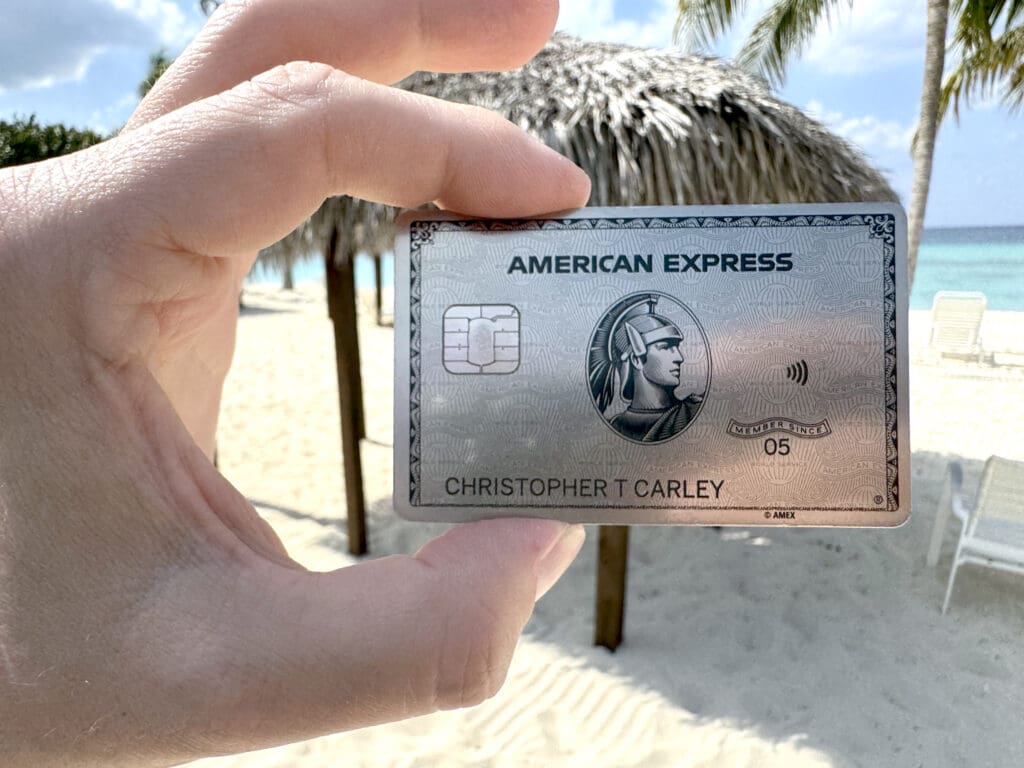
The Amex Platinum is the highest-tier card in this list — and at $695/year, it requires the most intentional use to justify. For frequent international travelers who use airport lounges, stay in luxury hotels, and value premium travel credits, the math works decisively in their favor.
Key specs:
| Detail | Value |
|---|---|
| Annual Fee | $695 |
| Welcome Bonus | 80,000 points after $8,000 spend in 6 months |
| Flights (direct or Amex Travel) | 5x points |
| Hotels via Amex Travel | 5x points |
| All Other Purchases | 1x |
| Airport Lounge Access | Centurion Lounges + Priority Pass + Delta Sky Clubs (on Delta flights) |
| Annual Airline Fee Credit | $200 (select airline) |
| Annual Uber Cash | $200 |
| Annual Hotel Credit | $200 (Fine Hotels + Resorts) |
| Saks Fifth Avenue Credit | $100/year |
| Global Entry / TSA PreCheck Credit | $100 |
| Total Annual Credits | $800+ |
Total credits vs fee: When all credits are utilized, the Amex Platinum delivers over $800 in credits against a $695 fee — a net positive position before a single point is earned. The 5x on flights and Amex Travel is the highest earn rate on airfare available on any mainstream US credit card.
Best for: Frequent international travelers (6+ flights/year), Centurion Lounge regulars, and cardholders who spend $10,000+/year on flights and hotels who will genuinely use all available credits.
6. Capital One Venture X — Best Value Premium Card

The Capital One Venture X is the newest entrant in the premium travel card space — and at $395/year with $300 in annual Capital One Travel credits and unlimited Priority Pass access, it offers the strongest value-to-fee ratio in the premium tier.
Key specs:
| Detail | Value |
|---|---|
| Annual Fee | $395 |
| Effective Annual Fee | ~$95 (after $300 travel credit + 10,000 anniversary miles) |
| Welcome Bonus | 75,000 miles after $4,000 spend in 3 months |
| Capital One Travel Purchases | 10x miles |
| Hotels + Rental Cars (via portal) | 5x miles |
| All Other Purchases | 2x miles |
| Annual Travel Credit | $300 (Capital One Travel) |
| Anniversary Miles | 10,000 miles each year ($100 value) |
| Airport Lounge Access | Priority Pass (unlimited guests) + Capital One Lounges |
| Global Entry / TSA PreCheck Credit | $100 |
| Transfer Partners | 15+ at 1:1 |
The effective fee calculation: $395 annual fee − $300 travel credit − $100 anniversary miles = $-5/year before any rewards are earned. The Venture X is the only premium travel card that effectively pays you to hold it before spending is considered.
Best for: Capital One Venture cardholders ready to upgrade, travelers who book through Capital One Travel regularly, and anyone who wants Priority Pass lounge access without the Amex Platinum price point.
Full Comparison: All 6 Cards
| Card | Annual Fee | Effective Fee | Welcome Bonus | Best Earn Rate | Transfer Partners | Best For |
|---|---|---|---|---|---|---|
| Chase Sapphire Preferred® | $95 | $45 | 60,000 pts | 3x dining | 14 | Beginners |
| Amex Gold® | $250 | ~$10 | 60,000 pts | 4x dining/grocery | 21 | Foodies |
| Capital One Venture® | $95 | ~$-5 | 75,000 miles | 2x everywhere | 15 | Flat-rate travel |
| Chase Sapphire Reserve® | $550 | ~$250 | 60,000 pts | 3x travel+dining | 14 | Heavy travelers |
| Amex Platinum® | $695 | ~$-100 | 80,000 pts | 5x flights | 21 | Luxury travelers |
| Capital One Venture X® | $395 | ~$-5 | 75,000 miles | 10x via portal | 15 | Best value premium |
How to Choose the Right Travel Card
You’re new to travel rewards and want to start simply: → Chase Sapphire Preferred — lowest barrier to entry, best transfer partner network for beginners, $95 fee easily justified
You spend heavily on food and want premium travel: → Amex Gold — 4x on dining and groceries, ~$10 effective fee, 21 transfer partners including ANA and British Airways
You want flat-rate rewards with no complexity: → Capital One Venture — 2x on everything, erase any travel purchase, no portal required
You travel frequently and want lounge access: → Chase Sapphire Reserve or Capital One Venture X — both provide Priority Pass; Venture X has better value at $395 vs $550
You fly internationally in business or first class regularly: → Amex Platinum — 5x on flights, Centurion Lounge access, strongest transfer partner network for premium cabin redemptions
The Transfer Partner Strategy: Where Real Value Is Unlocked
Every card in this list has transfer partners. Most cardholders never use them. Here are the highest-value transfers available right now for US travelers:
Chase points → World of Hyatt 25,000 points = free night at a Category 4 Hyatt ($200–$300 value). Best hotel transfer program in the US market for mid-range luxury travelers.
Amex points → ANA Mileage Club 88,000 points = round-trip business class US↔Japan ($6,000+ retail value). The highest single-redemption value available to US cardholders.
Capital One miles → Turkish Airlines Miles&Smiles 45,000 miles = round-trip business class to Europe on Star Alliance partners ($3,000+ retail value). Best-kept secret in the Capital One ecosystem.
Chase points → British Airways Avios 6,000 Avios = domestic American Airlines flight under 1,151 miles (~$100–$150 value). Exceptional for short-haul domestic travel at minimal point cost.
For a step-by-step breakdown of credit score requirements before applying for these cards, see our What Is a Good Credit Score guide. Most travel cards require 700+. The Sapphire Reserve and Amex Platinum typically require 720–740+.
Common Mistakes Travel Card Holders Make
- ❌ Redeeming points for cashback or gift cards — at 0.5–1¢/point, these are the lowest-value redemptions; even booking through the issuer’s portal delivers 1.25–1.5¢; airline transfers often deliver 2–3¢
- ❌ Ignoring annual travel credits — the $300 Chase Reserve credit and $300 Venture X credit apply automatically to travel purchases you’re already making; not using them is equivalent to paying an extra $300/year
- ❌ Applying for multiple travel cards at once — each hard inquiry costs 5–10 points; space applications at least 6 months apart and check your score at AnnualCreditReport.com before applying
- ❌ Not activating the welcome bonus spend window — most welcome bonuses require $4,000–$8,000 within 3–6 months; plan the application date around a large predictable expense (vacation, home project, semester costs)
- ❌ Keeping points in the account indefinitely — points don’t expire on most cards, but devaluations happen regularly; airline programs periodically increase award costs by 20–40% overnight. Redeem within 12–18 months of earning
For more on protecting your credit score while building a travel card portfolio, see our guide on mistakes that hurt your credit score.
Frequently Asked Questions
What is the best travel credit card in the USA?
The best travel credit card in the USA depends on your spending profile. The Chase Sapphire Preferred ($95/year) is the best entry-level option with a 60,000-point bonus and 3x on dining. The Amex Gold ($250/year, ~$10 effective) wins for households spending heavily on dining and groceries. The Capital One Venture X ($395/year, ~$-5 effective) offers the best value in the premium tier.
How many points do I need for a free flight?
It depends on the route, class, and program. Domestically, 6,000–15,000 points typically covers a short-haul flight. Internationally, 30,000–88,000 points covers business class depending on the program and destination. Chase Sapphire’s 60,000 welcome bonus books approximately 2 round-trip domestic flights or 1 international business class flight via the right transfer partner.
Do travel credit card points expire?
Most major travel card points do not expire as long as your account remains open and in good standing. Chase Ultimate Rewards, Amex Membership Rewards, and Capital One miles all have no expiration date on the points themselves. Airline miles transferred to partner programs have their own expiration rules — typically 18–24 months of inactivity triggers expiration.
What credit score do I need for a travel credit card?
Most entry-level travel cards like the Chase Sapphire Preferred and Capital One Venture require a good credit score of 700 or above. Premium cards like the Chase Sapphire Reserve and Amex Platinum typically require 720–740+. Check your score for free at AnnualCreditReport.com before applying. For guidance reaching the required score, see our credit score improvement guide.
Are travel credit card annual fees worth it?
For most travelers, yes — when the card is used actively. The Chase Sapphire Preferred’s $95 fee is offset by a $50 hotel credit, making the net cost $45. The Amex Gold’s $250 fee reduces to ~$10 after credits. The Capital One Venture X’s $395 fee becomes ~$-5 after the $300 travel credit and 10,000 anniversary miles. The fee is only not worth it for cardholders who don’t use the included credits or earn enough rewards to offset it.
Final Thoughts
The best travel credit card for you is the one that earns the most on how you actually spend — not how you plan to spend, and not the one with the most impressive-sounding bonus categories.
If food is your biggest category, the Amex Gold generates more annual value than any other card at its price point. If you want simplicity and flexibility, the Capital One Venture delivers 2x on everything with no decisions required. If you’re ready for premium lounge access and credits, the Venture X offers the strongest value-to-fee ratio in the market.
What every card in this list shares: a clear path from everyday American spending to real travel — flights, hotels, upgrades — that would otherwise come out of your pocket.
For more credit card reviews and travel rewards guides built for US consumers, visit CreditPilotUSA.com — your trusted co-pilot for navigating the world of credit.
Disclaimer: Card terms, point valuations, transfer partner availability, and annual fees are subject to change. Point values are estimates based on typical redemption patterns and do not represent guaranteed returns. Always verify current offers directly with each issuer before applying. This article is for educational purposes only and does not constitute financial advice.

Danilo is a Credit Analyst and the Founder of CreditPilotUSA.com. With deep expertise in the credit card industry, he translates complex banking news and reward systems into actionable financial strategies. Dedicated to helping Americans master their credit scores and maximize the cards in their wallets.