


Key Takeaways
- 1 in 5 Americans has at least one material error on their credit report, according to a Federal Trade Commission study — errors significant enough to raise interest rates or trigger loan denials.
- You have the legal right to dispute errors for free under the Fair Credit Reporting Act (FCRA). Bureaus must investigate within 30 days and remove anything they can’t verify.
- In 2026, bureau compliance has weakened — Experian’s consumer relief rate dropped from nearly 20% to under 1% following CFPB enforcement rollbacks. Knowing the escalation path is now more important than ever.
Editorial note: CreditPilotUSA.com provides financial education for US consumers based on federal law and verified data sources. This article is for educational purposes only and does not constitute legal advice.
Last updated: April 2026
What Is a Credit Report Error — and Why Should You Care?
A credit report error is any inaccurate, incomplete, or outdated information on your Equifax, Experian, or TransUnion report that misrepresents your creditworthiness.
The stakes are real. A single inaccurate late payment can drop a 750 FICO score by 60–100 points overnight. A fraudulent account you didn’t open can block a mortgage application entirely. And according to a landmark Federal Trade Commission study, one in five Americans carries at least one material error on their credit reports — errors significant enough to negatively affect their credit score or borrowing costs.
Complaints about incorrect information on credit reports increased by more than two and a half times between 2021 and 2023, and credit report errors became the single largest category of consumer complaints submitted to the CFPB.
The most common errors affecting American credit reports:
- Late payments you never actually missed — the most score-damaging error type
- Accounts you don’t recognize — could indicate identity theft or a mixed file
- Paid collections still showing as unpaid — incorrectly suppresses your score
- Duplicate collection entries — same debt reported twice by original creditor and collector
- Outdated debts past the 7-year reporting limit — should be removed automatically but often aren’t
- Wrong balance or credit limit — inflates your reported utilization ratio
- Unauthorized hard inquiries — costs 5–10 points per inquiry
Understanding which type of error you have determines the most effective dispute strategy.
How Does a Credit Report Error Happen?
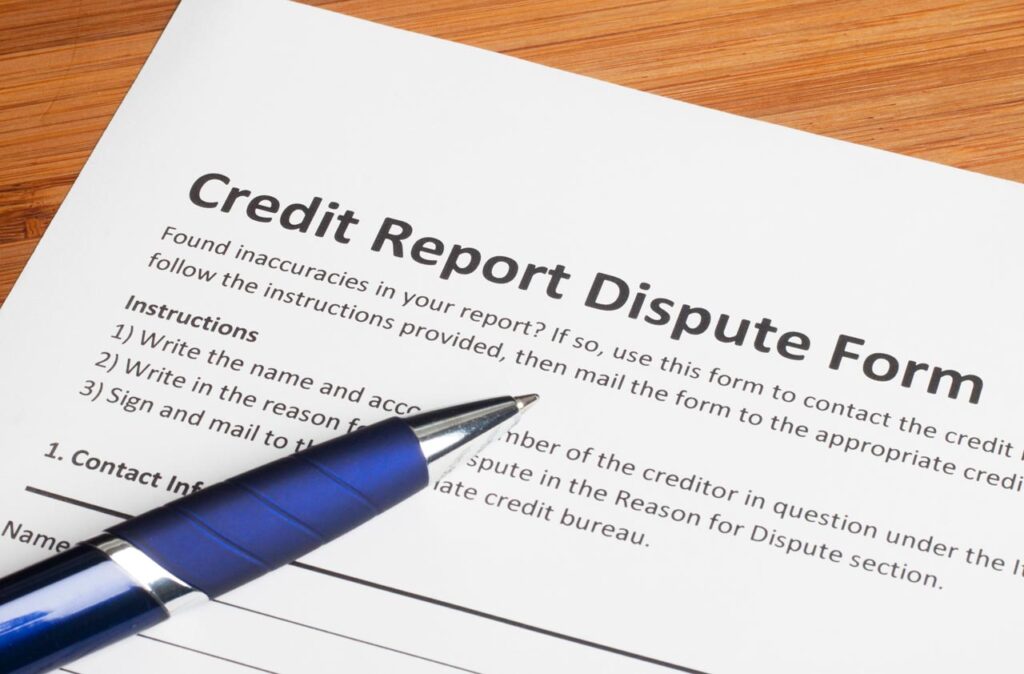
Most credit report errors trace back to one of three sources: lender reporting mistakes, identity theft, or mixed credit files.
Lenders report account data to the bureaus electronically every month. A single digit error in a Social Security Number, a system processing glitch, or a delayed payment update can create inaccurate entries across all three bureaus simultaneously. With millions of accounts updated monthly, the error rate is higher than the industry acknowledges publicly.
Mixed files occur when your credit data gets merged with someone else’s — typically a person with a similar name or SSN. A common scenario involves debt sold between collection agencies: your credit report can show the original charged-off account plus two separate collection entries for the exact same debt, making it appear you owe three times what you actually owe — devastating your credit utilization ratios.
Identity theft creates fraudulent accounts, hard inquiries, and false delinquencies in your name — sometimes without your knowledge for months or years.
Step 1: Get Your Credit Reports From All Three Bureaus
Pull your reports from Equifax, Experian, and TransUnion before filing any dispute. Errors on one bureau rarely appear identically on all three.
The only federally authorized free source is AnnualCreditReport.com — not the individual bureau websites, which promote paid monitoring products at the point of access. Free weekly reports from all three bureaus are currently available.
As a result of a 2019 settlement, US consumers may also request up to six free copies of their Equifax credit report during any twelve-month period through December 2026, in addition to the standard federally mandated free reports.
What to review on each report:
- Every account listed — recognize each one
- Payment history notations — confirm no payments are incorrectly marked late
- Delinquency dates on negative items — the 7-year clock starts here; a wrong date extends how long the item damages your score
- Balance and credit limit figures — errors here inflate your utilization ratio
- Hard inquiries — verify you authorized each one
- Personal information — name, address, SSN errors can indicate a mixed file
For the full breakdown of how long each negative item type must stay on your report under federal law, see our guide on how long does negative credit stay on your report.
Step 2: Identify and Document Every Error
Before filing, document each error with specific evidence — the dispute with the strongest supporting documentation gets resolved fastest.
For each error you find:
- Screenshot or print the specific entry showing the inaccurate information
- Gather evidence — bank statements, payment confirmations, loan payoff letters, police reports (for identity theft), court documents (for bankruptcy)
- Note the bureau(s) reporting each error — the same error may appear on one, two, or all three reports
- Record the account number, creditor name, and specific inaccuracy in writing
One error on all three bureaus requires three separate disputes — one per bureau. Disputing only with Equifax when the error appears on all three means the issue persists on two reports.
Step 3: File Your Dispute — Online, by Mail, or by Phone
Online disputes are the fastest — most bureaus process initial responses within 30 days. Certified mail disputes create a paper trail that’s invaluable if you need to escalate.
Online Dispute Portals (Fastest)
- Equifax: equifax.com/personal/credit-report-services/credit-dispute
- Experian: experian.com/disputes/main.html
- TransUnion: transunion.com/credit-disputes/dispute-your-credit
Upload your supporting documentation directly in the portal. Keep a screenshot of the submission confirmation with a timestamp.
Dispute by Certified Mail (Best Paper Trail)
For significant errors — fraudulent accounts, incorrect bankruptcies, major payment history errors — certified mail with return receipt creates legal documentation of when the bureau received your dispute. This matters if you need to escalate or sue.
Sample dispute letter structure (FCRA §611 compliant):
[Your Full Name] [Your Address] [Date]
[Bureau Name] [Bureau Address]
Re: Dispute of Inaccurate Information — Account #[Account Number]
Dear Sir or Madam,
I am writing to dispute the following inaccuracy on my credit report. The item described below is inaccurate for the reason stated:
Account Name: [Creditor Name] Account Number: [Last 4 digits] Error Description: [e.g., “This account shows a 30-day late payment on January 2025. I paid this account on time. See enclosed bank statement confirming payment cleared on January 12, 2025.”]
Under Section 611 of the Fair Credit Reporting Act, I request that you investigate this matter and correct or delete the inaccurate information. Please send me written notification of the results of your investigation.
Enclosed: [List your documents — bank statement, payment confirmation, etc.]
Sincerely, [Your Signature] [Your Name Printed] [Last 4 of SSN] [Date of Birth]
Step 4: Wait for the Investigation — Know Your Legal Rights
Under the FCRA, bureaus have 30 days to investigate your dispute and notify you of the result. If they cannot verify the information, they must remove it.
The Consumer Financial Protection Bureau (CFPB) enforces these timelines. If a bureau fails to investigate within 30 days, the disputed item must be deleted regardless of its accuracy.
The bureau contacts the creditor or data furnisher who reported the information. The furnisher must verify, correct, or delete the item within the investigation period. If the furnisher fails to respond, the bureau must remove the item.
What each outcome means:
| Outcome | What It Means | Your Score Impact |
|---|---|---|
| Error corrected | Bureau updates the information | Score reflects correction in next update cycle |
| Item deleted | Bureau removes it entirely | Score improvement within 30 days |
| Dispute denied | Bureau says information is verified accurate | Must escalate — see Step 5 |
| Dispute not completed in time | Bureau fails to meet 30-day deadline | Bureau must delete the item immediately |
Step 5: Escalate if the Bureau Denies Your Dispute
A denial is not the end. You have three escalation options — each more powerful than the last.
Option A: Dispute Directly with the Data Furnisher
Under FCRA Section 623, you can dispute errors directly with the company that reported the inaccurate information — the original creditor, collection agency, or lender — not just the bureau. Send a dispute letter to the creditor’s compliance address (not the customer service address) with the same documentation used in your bureau dispute.
When a creditor receives a direct FCRA dispute, they must investigate independently and cannot simply defer to the bureau’s verification process.
Option B: File a CFPB Complaint
2026 Context — Important: Experian’s consumer relief rate dropped from nearly 20% of complaints resolved in consumers’ favor in 2024 to less than 1% in 2025, following enforcement rollbacks at the CFPB. TransUnion’s relief rate fell by roughly half over the same period. Equifax did not show a similar decline.
Despite this, filing a CFPB complaint still creates a formal public record of your dispute and prompts a required company response. File at consumerfinance.gov/complaint with all correspondence attached.
Option C: Sue Under the FCRA
If a bureau or furnisher willfully ignores a verified error, you have the right to sue in federal court. Under FCRA Section 616, successful plaintiffs can recover actual damages, punitive damages up to $1,000 per willful violation, and attorney’s fees.
Find a consumer rights attorney through the National Association of Consumer Advocates at consumeradvocates.org. Many take FCRA cases on contingency — no upfront cost to you.
The 7-Year Rule: When Errors Should Have Been Deleted Already
Most negative information must be removed from your credit report after 7 years from the date of first delinquency — by law, automatically.
Many errors persist past their legal expiration date because bureaus don’t always catch every aging item. If you find a negative item that’s more than 7 years old (or 10 years for Chapter 7 bankruptcy), you can dispute it as “past the legal reporting period” — and the bureau must remove it without investigating the accuracy of the original information.
This is one of the fastest disputes to win. The only evidence you need is the date of first delinquency shown on the report itself.
How Credit Report Errors Affect Your Score Specifically
The score impact of a credit report error depends on which FICO factor the error distorts.
| Error Type | FICO Factor Affected | Typical Score Impact |
|---|---|---|
| Inaccurate late payment | Payment history (35%) | −60 to −110 points |
| Wrong balance/limit (inflates utilization) | Utilization (30%) | −20 to −80 points |
| Fraudulent account (new derogatory) | Payment history (35%) | −50 to −130 points |
| Duplicate collection entry | Payment history (35%) | −30 to −80 points |
| Unauthorized hard inquiry | New credit (10%) | −5 to −10 points per inquiry |
| Account aging error (wrong open date) | Length of history (15%) | Variable |
Understanding which factor is affected tells you how urgently to dispute. An error inflating your utilization — even by reporting the wrong credit limit — can be resolved in one billing cycle after correction. For the full mechanics of how utilization affects your score, see our guide on what is credit utilization and how it affects your score.
How to Monitor After Your Dispute Is Resolved
After a successful dispute, monitor your reports monthly for 90 days — deleted items occasionally reappear when furnishers re-report the same data.
This is called “reinsertion” and it’s regulated: if a deleted item reappears, the bureau must notify you within 5 business days and provide the furnisher’s contact information. You can then dispute the reinserted item as a fresh violation.
Free tools for ongoing monitoring:
- Credit Karma — weekly VantageScore from TransUnion and Equifax, plus alerts for new accounts and inquiries
- Experian app — monthly FICO Score 8, alerts for changes on your Experian report
For the full breakdown of the best free credit monitoring tools at every stage of credit building, see our guide on the best apps to improve your credit score.
What to Do After the Errors Are Gone
Removing errors is the fastest way to improve a credit score — faster than opening new accounts, faster than paying down balances, because you’re correcting misreported data rather than building new history.
Once the errors are resolved, the same fundamentals drive the score higher: consistent on-time payments, reported utilization under 10%, and aging accounts contributing to a longer history. For the complete framework on rebuilding your score after addressing errors, see our how to fix your credit score guide.
Frequently Asked Questions
How long does it take to remove a credit report error?
Bureaus have 30 days to investigate a dispute under the FCRA. If the information is unverifiable or the furnisher fails to respond within that window, the bureau must delete the item — meaning you could see results within 30–45 days of filing. Resolving complex errors involving identity theft or multiple data furnishers can take 60–90 days through the full escalation process.
Can I dispute a credit report error myself, or do I need a credit repair company?
You can dispute errors yourself for free — the process is legally identical to what credit repair companies do, and federal law prohibits them from doing anything you cannot do independently. Credit repair companies charge $50–$150/month for services available to you at no cost. The only situation where professional help adds value is complex identity theft cases with legal action, where a consumer rights attorney (not a credit repair company) is appropriate.
What if the bureau says my dispute is “frivolous”?
A bureau can mark a dispute frivolous if it lacks sufficient evidence or is substantially the same as a previous dispute. If this happens, add more specific documentation — bank statements, payment confirmations, police reports — and refile. If you believe the frivolous designation is itself erroneous, file a CFPB complaint and consider consulting a consumer rights attorney, as wrongly denying disputes violates the FCRA.
Final Thoughts
Credit report errors are common, consequential, and correctable. The FCRA gives you free, enforceable rights to dispute any inaccurate information — and bureaus must remove what they cannot verify.
In 2026, with bureau enforcement at its weakest in a decade, knowing the full escalation path matters more than it once did. Don’t stop at a bureau denial. Use the direct furnisher dispute, the CFPB complaint, and if necessary, the federal lawsuit option that the FCRA explicitly provides.
Your credit report is a financial document that determines your borrowing costs for decades. Getting it right is worth the hour it takes to dispute it.
For more guides on credit scores, credit cards, and personal finance strategy built for US consumers, visit CreditPilotUSA.com — your trusted co-pilot for navigating the world of credit.
Disclaimer: This article provides general educational information based on federal law as of April 2026. Credit bureau policies and CFPB enforcement priorities are subject to change. This is not legal advice. Consult a qualified consumer rights attorney for advice specific to your situation.

Danilo is a Credit Analyst and the Founder of CreditPilotUSA.com. With deep expertise in the credit card industry, he translates complex banking news and reward systems into actionable financial strategies. Dedicated to helping Americans master their credit scores and maximize the cards in their wallets.