

If you had to identify the single most misunderstood factor in the American credit scoring system, credit utilization would be a strong candidate.
Most people know it exists. Most know it’s related to credit cards. Very few understand how it’s actually calculated — or why the timing of when you pay matters as much as whether you pay.
This guide explains exactly what credit utilization is, why it controls 30% of your FICO score, how it’s measured (including the detail most articles skip), and the precise steps to lower it fast.
Editorial note: CreditPilotUSA.com provides credit education based on FICO scoring methodology. This article is for educational purposes only.
Last updated: March 2026
Quick Answer
Credit utilization is the ratio of your credit card balances to your credit limits — expressed as a percentage. It accounts for 30% of your FICO score. Keeping total utilization under 10% produces the best scoring outcomes; over 30% begins to cause score damage. The critical detail most people miss: utilization is calculated based on the balance reported on your statement closing date, not your payment due date — which means the timing of when you pay within the billing cycle directly affects your score.
What Is Credit Utilization?
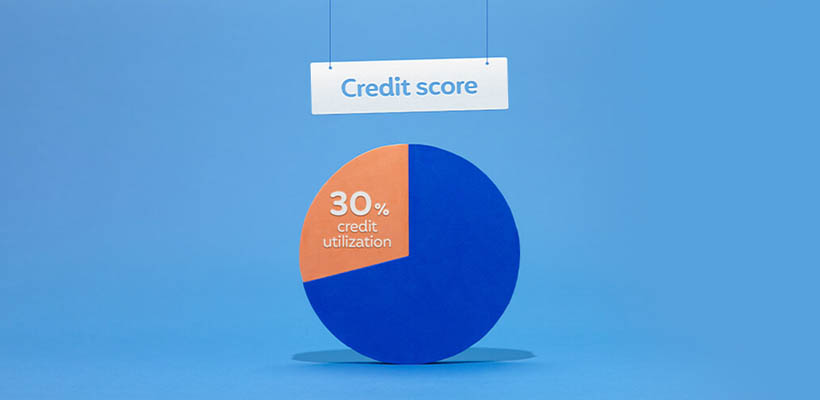
Credit utilization measures how much of your available revolving credit you are currently using. It is calculated in two ways:
Per-card utilization: Each individual credit card’s balance ÷ its credit limit
Aggregate utilization: Total balances across all cards ÷ Total credit limits across all cards
Both calculations feed into your FICO score. Having one card at 80% utilization hurts your score even if your overall utilization is low — scoring models penalize high utilization on individual accounts, not just the total.
Simple example:
| Card | Balance | Limit | Utilization |
|---|---|---|---|
| Card A | $800 | $2,000 | 40% |
| Card B | $200 | $3,000 | 6.7% |
| Card C | $0 | $1,000 | 0% |
| Total | $1,000 | $6,000 | 16.7% |
In this example, your aggregate utilization is 16.7% — but Card A at 40% is individually penalizing your score even though your overall ratio is moderate. Paying Card A down to $200 would bring Card A’s utilization to 10% and aggregate utilization to 6.7%.
Why Utilization Is 30% of Your Score
FICO scoring is built on five factors:
| Factor | Weight |
|---|---|
| Payment History | 35% |
| Credit Utilization | 30% |
| Length of Credit History | 15% |
| Credit Mix | 10% |
| New Credit | 10% |
At 30%, utilization is the second-most powerful factor in your score — and unlike payment history, which builds slowly through years of on-time payments, utilization can change dramatically within a single billing cycle. This makes it the fastest legitimate lever for score improvement available to any American cardholder.
The FICO algorithm is sensitive to utilization at multiple thresholds. Research and cardholder data consistently show the scoring sweet spots:
| Utilization Level | Score Impact |
|---|---|
| 0–7% | Optimal — maximum scoring benefit |
| 8–10% | Excellent — minimal difference from 0–7% |
| 11–20% | Good — score largely unaffected |
| 21–30% | Moderate — beginning to show scoring pressure |
| 31–50% | Significant damage — meaningful score reduction |
| 51–75% | Severe damage — major score reduction |
| 76–100% | Maximum damage — treating the limit as a floor |
People with FICO scores above 800 carry average utilization of under 7%. People with scores in the 600–650 range typically carry 30–50%. The utilization difference alone explains a substantial portion of that scoring gap.
The Detail Most Articles Skip: Statement Date vs. Due Date
This is the most important and least understood aspect of credit utilization management — and getting it right is the difference between accidentally reporting high utilization and strategically reporting low utilization every month.
Your creditor reports your balance to the bureaus once per month — on your statement closing date.
This is not your payment due date. Your payment due date is typically 21–25 days after your statement closes. The bureaus receive your balance at statement close — whatever is on your account at that moment becomes your reported utilization. What happens between statement close and the due date is invisible to scoring models.
The practical consequence:
Suppose your card has a $2,000 limit and you spend $1,200 in a month — consistent with your usual spending. Your statement closes on the 15th. On the 15th, your balance is $1,200 — that’s 60% utilization, reported to all three bureaus. On the 30th (your due date), you pay the full $1,200 — zero interest, responsible behavior, perfect payment history.
Your FICO score, however, sees 60% utilization for that billing cycle. The bureaus recorded the balance at statement close, not at payment.
The fix: Pay your balance down to under 10% of your limit before your statement closes — not just before your due date. Set a calendar reminder 5–7 days before your statement closing date each month. Make the early payment. Let the statement close with the low balance. Pay the remainder by the due date as usual.
Result: bureaus see under 10% utilization, zero interest charges, perfect payment history. For the full month-by-month breakdown of this strategy, see our guide on how to fix your credit score.
How to Find Your Statement Closing Date
Most cardholders don’t know this date off the top of their head. Here’s how to find it in 60 seconds:
- Mobile app → tap “Statements” or “Account Activity” → the closing date appears at the top of your most recent statement
- Card website → navigate to “Statements” → closing date is listed on each statement
- Call the number on the back of your card → ask for your current billing cycle closing date
Once you have it, it stays consistent month-to-month (usually the same day each month). Set a recurring reminder 5–7 days before it.
6 Ways to Lower Your Credit Utilization Fast

1. Pay down balances before statement close
The most direct method. Target the card with the highest individual utilization first, then work down the list. Paying $500 off a card at 80% utilization ($400 limit) has more scoring impact than paying $500 off a card at 15% utilization.
2. Request a credit limit increase
Same balance, higher limit = lower utilization. Most major issuers allow limit increase requests through their mobile app with no hard inquiry. After 12 months of on-time payments, the approval odds are strong. A limit increase from $2,000 to $3,500 on a card with a $600 balance drops utilization from 30% to 17% with zero paydown required.
3. Open a new credit card
A new card adds to your total available credit — which lowers aggregate utilization. Caution: the new card also adds a hard inquiry (−5 to −10 points temporarily) and lowers average account age. This strategy works best when your score is already strong enough that the short-term impact is recoverable, and you’re planning to open a new card anyway for rewards.
4. Distribute balances across multiple cards
If you’re carrying $1,500 on a single $2,000 card (75% utilization), transferring $500 to another card with available limit can reduce per-card utilization on the first card from 75% to 50% — still high, but less damaging. Spreading balances more evenly reduces the individual card penalty.
5. Make multiple payments per month
Some cardholders make a payment mid-cycle to bring the balance down before statement close, then a second payment after the due date. This is the two-payment approach — mid-cycle payment manages utilization, due-date payment manages payment history. Both are clean habits.
6. Keep old cards open and active
Closing an old card removes its credit limit from your total available credit — which mechanically increases utilization. Keep old cards open with a small recurring charge (a streaming subscription) to maintain the available limit and keep the account active.
What Counts Toward Utilization — and What Doesn’t
Does count toward utilization:
- Credit card balances (Visa, Mastercard, Amex, Discover)
- Store credit cards
- Charge cards (counted differently — some models exclude them)
- Credit lines attached to revolving accounts
Does NOT count toward utilization:
- Mortgages
- Auto loans
- Student loans
- Personal installment loans
- Debit card spending
- Buy-now-pay-later (BNPL) balances — typically not reported
- Rent payments
This is why utilization is specifically a revolving credit metric — it measures how much of your credit card capacity you’re using, not your total debt picture.
The Utilization Reset: How Fast Does It Change?
Utilization is one of the most responsive factors in the FICO algorithm. Because it’s recalculated every month based on fresh reported data, a change in your reported balance reflects in your score within one billing cycle — approximately 30 days.
There is no “memory” of high utilization in the FICO calculation. If your card reported 80% utilization last month and reports 8% this month, your score this month reflects 8% — the prior month’s high utilization does not carry forward as a penalty. This makes utilization management the fastest tool for short-term score improvement available to any cardholder.
For context: a late payment from last month stays on your report for 7 years. A high utilization month from last month disappears from the score calculation in 30 days. The asymmetry is significant.
Frequently Asked Questions
What is a good credit utilization ratio?
Under 10% is considered excellent for FICO scoring purposes. Under 30% avoids significant score damage. The optimal range for people targeting 750+ scores is under 7% — which matches the average utilization carried by Americans with Exceptional credit scores.
Does paying your full balance every month help utilization?
It depends on timing. If you pay your full balance by the due date but your statement already closed with a high balance, the bureaus recorded the high utilization. To benefit your score, you need to pay the balance down before the statement closes — not just before the due date.
Does having zero utilization hurt your score?
Some scoring advice suggests that 0% utilization (no reported balance at all) can be slightly less optimal than 1–7% utilization — because some models prefer to see some revolving account activity. In practice, the difference between 0% and 5% utilization on your score is negligible. The meaningful thresholds are under 10%, under 30%, and under 50%.
How much does credit utilization affect my score?
Credit utilization accounts for 30% of your FICO score — making it the second most powerful factor. Reducing utilization from 60% to under 10% can add 40–80 points within a single billing cycle for cardholders who don’t have other major negative items. The exact impact depends on your full credit profile.
Does utilization on a debit card affect my credit score?
No. Debit card spending is never reported to credit bureaus and has zero impact on your credit score or utilization ratio. Only revolving credit accounts (credit cards, lines of credit) factor into utilization calculations.
Final Thoughts
Credit utilization is the fastest-moving piece of your credit score — and the most directly controllable.
Unlike payment history, which requires years of consistent behavior to build, or account age, which requires time you can’t accelerate, utilization responds within 30 days to deliberate action. Pay down your highest-utilization card before your statement closes this month and you will see the result in your next score update.
The two numbers to remember: under 10% for optimization, under 30% to avoid active damage. Everything else is refinement.
For the complete credit score repair framework that puts utilization in context with every other scoring factor, see our how to fix your credit score guide.
Disclaimer: FICO scoring thresholds described are based on industry research and cardholder data patterns. Exact score impacts vary by individual credit profile. FICO models are proprietary. This article is for educational purposes only.

Danilo is a Credit Analyst and the Founder of CreditPilotUSA.com. With deep expertise in the credit card industry, he translates complex banking news and reward systems into actionable financial strategies. Dedicated to helping Americans master their credit scores and maximize the cards in their wallets.