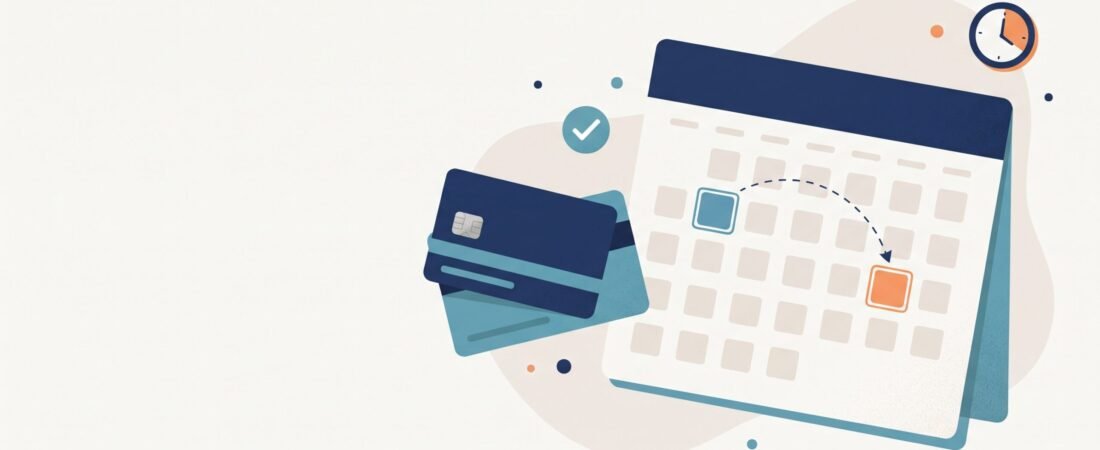
Short answer: The closing date is the last day of your billing cycle, when your statement is created. The due date is the deadline to pay. To avoid interest on purchases, you generally need to pay your statement balance in full by the due date, if your card has a grace period. To avoid a late fee, you need at least the minimum payment received by the due date. Those are two different dates with two different jobs.
If you also want to know which amount to pay, see our guide to statement balance vs. current balance.
What each date means
- Closing date (statement date): According to Citi, this is the last day charges can be applied to the current statement. Your issuer then tallies transactions, interest and fees to produce the statement balance. Billing cycles typically last 28 to 31 days.
- Due date: Citi describes it as your deadline to pay at least the minimum, falling on the same date each month. Missing it or paying only part of the required minimum counts as late. Late fees and a penalty APR are possible, depending on your card agreement.
The gap between the two is your grace period. The CFPB defines it as the time between the end of the billing cycle and the payment due date. Federal law requires issuers to deliver your statement at least 21 days before the due date (15 U.S.C. § 1666b). Many issuers give more time. Citi, for example, says its due dates fall at least 25 days after closing. That is an issuer-specific policy, not the federal minimum.
A hypothetical calendar
Everything below is invented for illustration. It isn’t a real account or issuer policy.
Hypothetical card: closing date Nov 10, due date Dec 5, credit limit $2,000, minimum payment $35.00.
| Date (2026) | Day | What happens |
|---|---|---|
| Oct 11 | Sun | Billing cycle begins |
| Nov 6 | Fri | Early-payment option (see below) |
| Nov 10 | Tue | Closing date. Cycle ends. Statement balance is set at $640.00 |
| Nov 11 | Wed | New cycle begins. New purchases go to the next statement |
| Dec 4 | Fri | Safest day to pay online |
| Dec 5 | Sat | Due date (falls on a Saturday) |
| Dec 7 | Mon | Next business day (see the weekend rule below) |
| Dec 10 | Thu | Next closing date |
Checks: The cycle from Oct 11 to Nov 10 is 31 days. From the closing date (Nov 10) to the due date (Dec 5) is 25 days. The next cycle, Nov 11 to Dec 10, is 30 days.
When to pay: two hypothetical windows
Say your balance reaches $640.00 by Nov 6, and you make no other purchases or payments.
| Option | What you do | Statement balance | Balance as a share of the $2,000 limit* | Interest on these purchases (grace period assumed) |
|---|---|---|---|---|
| A: pay before closing | Pay $400.00 on Nov 6, posting before Nov 10. Pay the remaining $240.00 by Dec 5. | $240.00 | 12.0% | None |
| B: pay at the due date | Pay $640.00 on Dec 4. | $640.00 | 32.0% | None |
*Issuers often report a balance close to the statement balance after the cycle ends, per Experian. Your issuer’s timing may differ.
Both options cost the same, $640.00 in total, and both avoid interest if your card has a grace period. They differ only in the balance that appears on the statement. Check: $240 ÷ $2,000 = 12.0%, and $640 ÷ $2,000 = 32.0%. Paying before the closing date is one way to lower the balance your issuer may report, as American Express also notes.
Where does a purchase land? A second illustration
A purchase’s date decides which statement it appears on, which changes how long you have to pay for it. Using the same calendar:
| Purchase of $120 on | Appears on statement closing | Due date | Days from purchase to due date |
|---|---|---|---|
| Nov 9 (before closing) | Nov 10 | Dec 5 | 26 days |
| Nov 11 (after closing) | Dec 10 | Jan 4, 2027 | 54 days |
Days check: Nov 9 to Dec 5 is 21 + 5 = 26. Nov 11 to Jan 4 is 19 + 31 + 4 = 54. This is a timing observation, not a reason to spend more. A purchase made on the closing date itself may land on the next statement, because pending transactions can take a day or more to post, per American Express.
What “on time” means
Per the CFPB:
- Issuers generally can’t treat a payment as late if it is received by 5 p.m. on the due date, in the time zone stated on your statement.
- If the due date falls on a day the issuer doesn’t receive or accept mail, such as a weekend or holiday, you generally have until 5 p.m. on the next business day.
- Issuers may set a reasonable cut-off time for online payments, and in-person cut-offs can be earlier than 5 p.m.
- The payment must be received by the due date, not just sent.
In our calendar, the due date is Saturday, Dec 5. The CFPB’s next-business-day language refers to days when the issuer isn’t accepting mail. Whether your card accepts an online payment on a Saturday depends on the issuer, so the safe move is to pay on Friday, Dec 4.
Risks and exceptions
- No grace period: Some cards or balances don’t have one. Not all cards offer an interest-free grace period, even though issuers must give you at least 21 days to pay. If you pay less than the statement balance, see how that affects interest in our guide to statement balance vs. current balance.
- Cash advances and balance transfers: The CFPB notes grace periods typically cover only purchases.
- Different dates across cards: Each card has its own closing date and due date. Check each one.
- Closing dates can shift: Cycles run 28 to 31 days, so the date may move slightly. Check every statement.
- Late payments and credit reports: Citi notes a payment 30 or more days late can be reported to the credit bureaus. A shorter delay can still bring fees and interest.
Practical next steps
- Find your closing date, due date and time zone on your latest statement or in your app.
- Add both dates to your calendar, plus a reminder two business days before the due date.
- Pay at least the minimum on time every month. If you want no interest, pay the statement balance in full.
- If your due date falls on a weekend or holiday, pay on the business day before.
- Optionally, make an extra payment before the closing date to lower the balance on the statement.
- Confirm the payment posted. A submitted payment is not always a received payment.
FAQ
Is the closing date the same as the due date?
No. The closing date ends the billing cycle. The due date comes later and is your payment deadline.
Can my due date change?
Citi says it falls on the same date each month, but issuers can change terms. Watch your statements for notices.
What if I pay between the closing date and the due date?
That is the normal window. The payment counts toward the statement that just closed.
Is paying before the closing date allowed?
Yes. It reduces the statement balance, as in Option A. You still need to pay any remaining statement balance by the due date.
This article is educational and not financial or legal advice. Dates, cut-off times and fees vary by issuer, so check your card agreement.

Danilo is a credit analyst and the founder of CreditPilotUSA.com. He writes about credit cards, personal loans, and credit scores for U.S. consumers, turning complex financial topics into clear, practical explanations. His focus is helping readers understand borrowing costs, compare options, and make informed decisions about building credit and managing debt.