

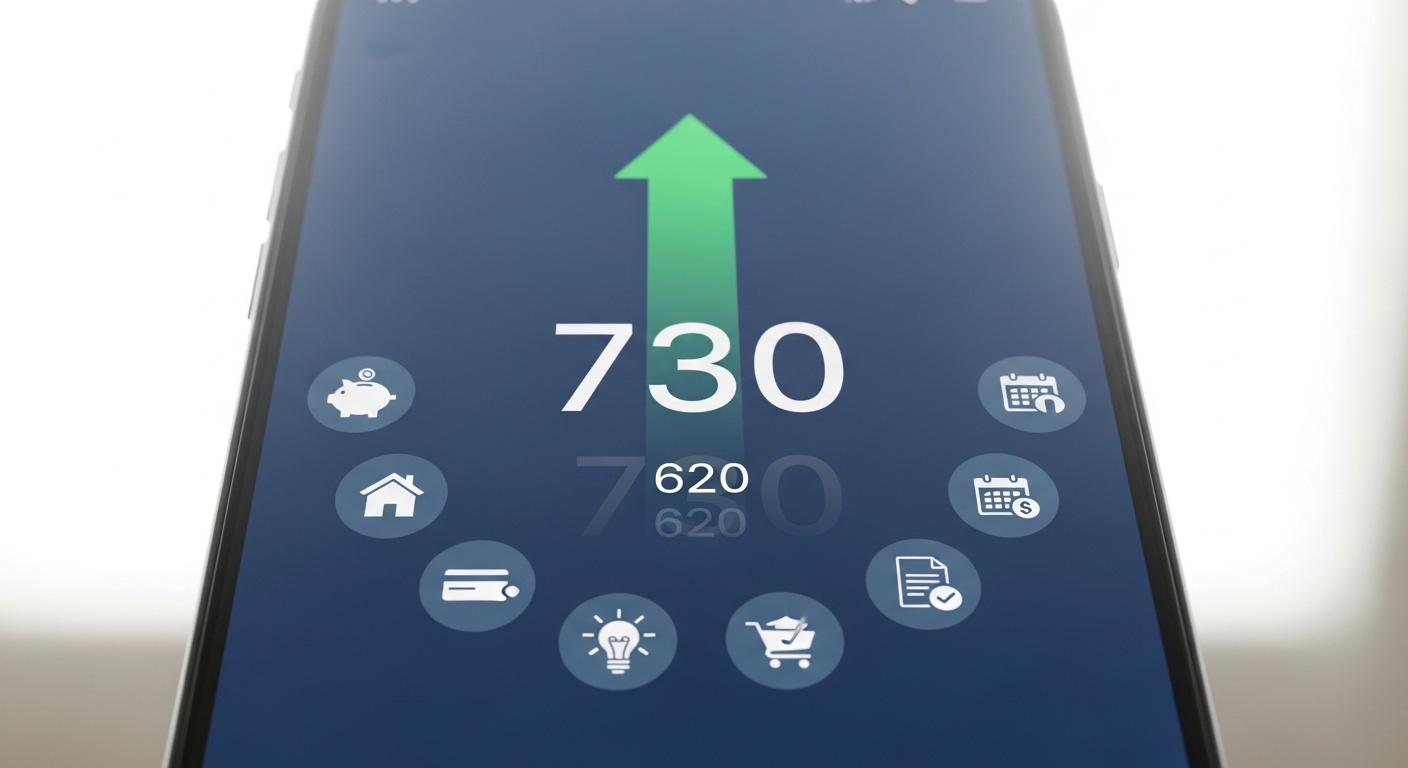
Most people trying to improve their credit score are waiting for time to do the work.
They made a mistake months ago, they know it’s on their report, and now they’re just… waiting. Checking their score every few weeks hoping the number moved. Avoiding credit applications because they’re not sure where they stand.
Here’s what most of them don’t realize: the two factors that control 65% of your FICO score respond to behavior changes within 30 days. Time matters — but the right habits matter more. And most of the habits that move the needle fastest require no money, no credit repair service, and no complicated strategy.
These daily routines will help you maintain a great profile, but for a full technical breakdown, check our step-by-step tutorial on how to build your credit score fast.
Editorial note: CreditPilotUSA.com provides credit education based on FICO scoring methodology and real cardholder data. This article is for educational purposes only.
Last updated: March 2026
Habit 1: Pay Before Your Statement Closes — Not Just Before the Due Date
This is the single habit that surprises people the most — and moves the needle the fastest.
Most Americans know that paying on time is important. What most don’t know is that when you pay within the billing cycle changes what gets reported to the credit bureaus.
Your card issuer reports your balance to Equifax, Experian, and TransUnion once a month — on your statement closing date, not your payment due date. Whatever balance is on your account at that moment becomes your reported utilization ratio, which feeds directly into 30% of your FICO score.
If your limit is $1,000 and your statement closes with a $600 balance, the bureaus see 60% utilization — even if you pay every dollar by the due date and never pay interest. The damage to your score happens at statement close.
The fix: pay your balance down to under 10% of your limit before your statement closes each month. Set a calendar reminder 5 days before your closing date. Make the payment. Watch the reported utilization drop. Most cardholders see the score impact within one billing cycle — sometimes 20 to 50 points from this single change alone.
Habit 2: Never Miss a Payment — Even the Minimum
Payment history controls 35% of your FICO score — more than any other single factor. And a single missed payment can drop a 700+ score by 60 to 110 points overnight.
The most common reason people miss payments isn’t financial hardship — it’s forgetting. A travel week, a busy month, a billing cycle that fell on a holiday. One overlooked due date.
The solution is mechanical, not motivational: set autopay for the minimum payment on every card you own. Not because you plan to carry a balance, but because autopay is a safety net that ensures the bureaus never see a missed payment regardless of what else is happening in your life.
Then pay the full balance manually, before the statement closes, as described in Habit 1. The autopay minimum is insurance. The manual early payment is optimization. Both run simultaneously.
This combination — autopay as the floor, early manual payment as the ceiling — is how people with 800+ scores operate consistently. See our full list of mistakes that hurt your credit score to understand what derails this habit most often.
Habit 3: Keep Every Old Card Open — Even the Ones You Don’t Use
The age of your credit accounts makes up 15% of your FICO score, and the calculation rewards the oldest accounts most heavily.
Here’s where most people make a costly mistake: they pay off an old card they don’t use anymore and close it to “clean up” their wallet. This removes years — sometimes decades — of credit history from their profile overnight. It also reduces their total available credit, which mechanically increases their utilization ratio.
A card you’ve had for 8 years that you haven’t used in 2 years is one of the most valuable assets on your credit report. It demonstrates long, unbroken credit history and adds to your total credit availability.
The right approach: Keep old cards open. Put a small recurring charge on them — a $10 monthly streaming subscription, a gas fill-up every few months — to keep the account active and prevent the issuer from closing it due to inactivity. Pay the balance in full each month. Total effort: about 5 minutes per year.
Habit 4: Request a Credit Limit Increase Every 12 Months

This habit is free, takes 2 minutes, and has a direct mechanical effect on your utilization ratio.
Your credit utilization ratio = your balance ÷ your credit limit. If you’re spending $500/month and your limit is $1,000, your utilization is 50%. If your limit increases to $2,000 — with the same $500 in spending — your utilization drops to 25%. Same spending, lower score-damaging ratio.
Most major card issuers offer credit limit increases through their mobile app or website with no hard inquiry required — making it a no-risk action. The best time to request is after 12 months of on-time payments, when issuers are most likely to approve.
The cadence: Request a limit increase every 12 months on each of your cards. Over 2 to 3 years, this habit alone can push available credit high enough that your utilization stays low even during months of higher-than-usual spending.
Habit 5: Become an Authorized User on a Strong Account
This is one of the fastest credit-building shortcuts available — and it costs nothing if you know the right person.
When someone with excellent credit adds you as an authorized user on their credit card, the entire history of that account can appear on your credit report. If the primary cardholder has a 7-year-old account with no late payments and low utilization, you may inherit years of positive history overnight.
You don’t need to use the card. You don’t even need to receive it. The credit-building benefit comes entirely from the reporting — as soon as the primary cardholder’s issuer reports the account to the bureaus with your name on it.
What to look for in an authorized user account: long history (older is better), consistent on-time payment record, and low utilization (under 30%). One late payment on the primary account will appear on your report too — so choose carefully.
For people at lower score ranges who need a faster path to 650+, this single action can produce results faster than almost any other strategy. Pair it with your own secured card from our best credit cards for beginners guide for a dual-track approach.
Read also: How marriage affects your credit score
Habit 6: Space Out New Credit Applications — At Least 6 Months Apart
Every time you apply for a credit card, personal loan, or auto loan, the lender runs a hard inquiry on your credit report. Each hard inquiry costs approximately 5 to 10 points and stays on your report for 2 years.
One inquiry is minor. Three inquiries in 90 days starts to signal financial stress to scoring models — and the compounding effect on your score is more damaging than the sum of individual inquiries.
The habit is simple: apply for new credit intentionally, not impulsively. Research the card, confirm you meet the approval requirements, and apply when you’re ready — not because you saw a sign at a checkout counter or received a pre-approval mailer.
Space applications at least 6 months apart. Check your score at AnnualCreditReport.com before applying for any new product to avoid surprises. The goal is to add positive accounts to your profile over time — not to chase every offer that arrives.
For guidance on which cards are worth applying for at your current score range, see our improve credit score from 500 to 700 guide.
Habit 7: Monitor Your Report Monthly and Dispute Errors Immediately
One in five Americans has an error on their credit report significant enough to affect their score — according to a study cited by the Consumer Financial Protection Bureau. Many of those errors are sitting there unnoticed, costing real points every month.
The most common errors: accounts that don’t belong to you (identity theft or mixed files), incorrect late payment dates that restart the 7-year clock, duplicate collection entries for the same debt, and balances that haven’t been updated after being paid off.
The habit: Check your credit report monthly using a free monitoring tool — and review the full report from all three bureaus at least once per year at AnnualCreditReport.com.
When you find an error, dispute it directly with the bureau reporting it. Under the Fair Credit Reporting Act, bureaus must investigate within 30 days and remove any item they cannot verify. A single successful dispute on a significant negative item can add 20 to 50 points — immediately, with no waiting period.
For the best free tools to monitor your score and catch errors in real time, see our guide on the best apps to improve your credit score.
How These 7 Habits Work Together
None of these habits is complicated. None requires a credit repair company, a financial advisor, or any spending beyond what you’re already doing.
What they require is consistency — and a basic understanding of which behaviors the FICO algorithm rewards and when.
Here’s the combined impact for someone starting at 600 who implements all seven habits over 12 months:
| Habit | FICO Factor Targeted | Typical Impact | Speed |
|---|---|---|---|
| Pay before statement closes | Utilization (30%) | +20 to +50 pts | 1 billing cycle |
| Never miss a payment | Payment history (35%) | +15 to +40 pts cumulative | Ongoing |
| Keep old cards open | Length of history (15%) | Prevents loss of 10–30 pts | Immediate |
| Request limit increases | Utilization (30%) | +10 to +25 pts | 1–2 cycles after approval |
| Become authorized user | History + utilization | +20 to +50 pts | 1–2 billing cycles |
| Space new applications | New credit (10%) | Prevents -5 to -20 pts per inquiry | Ongoing |
| Monitor and dispute errors | All factors | +20 to +50 pts per resolved dispute | 30–45 days per dispute |
Combined 12-month result for a consistent practitioner starting at 600: Most people implementing all seven habits reach 680–720 within 12 months — without opening new accounts, without paying for credit repair, and without any action beyond managing what they already have.
The score doesn’t move because of time. It moves because of these habits.
Start With One
If reading this list feels overwhelming, start with Habit 1.
Find your statement closing date in your card’s app. Set a calendar reminder 5 days before it. Pay your balance to under 10% of your limit before that date next month.
That’s it. One change. One reminder. Check your score in 35 days.
Then add the next habit. Then the next. By the end of the year, you won’t be the person waiting for time to fix your credit. You’ll be the person who fixed it.
For more credit strategies, card reviews, and guides built for US consumers at every stage of their credit journey, visit CreditPilotUSA.com — your trusted co-pilot for navigating the world of credit.
Disclaimer: Credit score improvements vary based on individual credit profiles. FICO scoring models are proprietary and subject to change. Estimates are based on general scoring patterns and do not represent guaranteed results. Information provided is for educational purposes only.

Danilo is a Credit Analyst and the Founder of CreditPilotUSA.com. With deep expertise in the credit card industry, he translates complex banking news and reward systems into actionable financial strategies. Dedicated to helping Americans master their credit scores and maximize the cards in their wallets.