

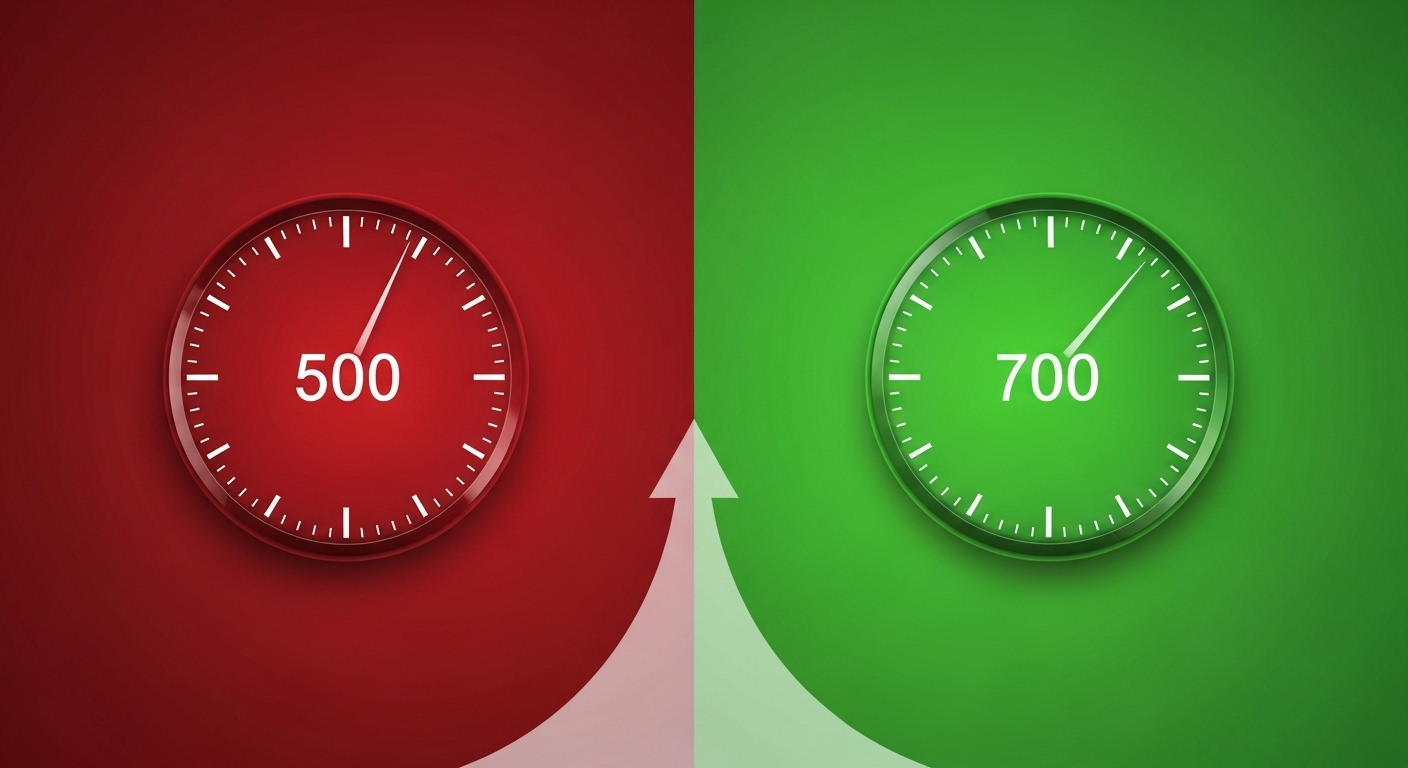
A 500 credit score isn’t a life sentence. It’s a starting point — and the distance between 500 and 700 is shorter than most people think.
Going from 500 to 700 on the FICO scale means crossing from “poor” into “good” territory. That single leap unlocks a completely different financial life: better credit cards, lower interest rates on car loans, easier apartment approvals, and access to financial products that simply aren’t available below that threshold.
The frustrating part is that most people with a 500 score don’t know exactly what got them there — or exactly what will move them out. This guide fixes that. You’ll get a clear, step-by-step plan to improve your credit score from 500 to 700, with realistic timelines, proven strategies, and the specific actions that produce the fastest results.
No vague advice. No “just pay your bills on time.” A real roadmap — built around how FICO scoring actually works.
Quick Answer
To improve your credit score from 500 to 700, focus on the two highest-impact factors: pay every bill on time without exception, and bring your credit card balances below 10% of your available limit. Most people who apply these two strategies consistently see their score cross 700 within 12 to 18 months. Adding a secured card and disputing any credit report errors can accelerate the timeline.
What a 500 Credit Score Actually Means
A 500 FICO score falls in the “poor” range (300–579). It tells lenders you’ve had significant credit challenges — missed payments, high utilization, collections, or simply very limited credit history.
Here’s what life looks like at 500:
- Most unsecured credit cards will decline your application
- Auto loan rates can reach 15–25% APR — sometimes higher
- Many landlords will require a larger security deposit or deny your application outright
- Personal loan options are limited to high-interest lenders
- Premium rewards cards and travel cards are completely out of reach
But here’s the critical insight: a 500 score is rarely permanent damage. In most cases, it’s the result of a few specific negative items that can be addressed directly — and positive behavior that starts today begins offsetting that damage within 30 to 90 days.
Why Your Score Is at 500 — The 5 Most Common Causes
Before you can fix a credit score, you need to understand what broke it. Pull your free credit reports from all three bureaus at AnnualCreditReport.com and look for these five culprits:
1. Late or missed payments The single most common cause of a low score. Payment history is 35% of your FICO score — one 90-day late payment can drop a good score by 100+ points and stays on your report for seven years.
2. High credit utilization Using more than 50–70% of your available credit limit is a red flag to scoring models. A maxed-out card can suppress your score by 50–100 points on its own, even if you’ve never missed a payment.
3. Collections accounts An unpaid debt that went to a collection agency creates a severe negative mark. Medical bills, utility debts, and old credit card balances that go unpaid often end up here — sometimes without the borrower realizing it.
4. Too few accounts or thin credit file Some people score in the 500s simply because they have one or two accounts and not enough credit history for the model to produce a high score. This is one of the most fixable situations — adding the right accounts changes things quickly.
5. Recent hard inquiries or new accounts Applying for multiple credit products in a short window stacks hard inquiries and signals financial stress. Each inquiry drops your score by 5–10 points — harmless individually, damaging in clusters.
The FICO Score Breakdown — Where Your Points Come From
Understanding exactly what FICO measures tells you exactly where to focus your energy:
| Factor | Weight | Your Priority |
|---|---|---|
| Payment History | 35% | 🔴 Highest priority — non-negotiable |
| Credit Utilization | 30% | 🔴 Fastest to change — act immediately |
| Length of Credit History | 15% | 🟡 Slow to build — don’t shorten it |
| Credit Mix | 10% | 🟡 Add strategically when ready |
| New Credit Inquiries | 10% | 🟢 Protect — apply only when necessary |
65% of your score lives in just two factors. This is where almost all of your effort should go in the first 6–12 months.
The Step-by-Step Roadmap: 500 to 700
Phase 1: Weeks 1–4 — Diagnose and Stop the Bleeding
Step 1: Pull all three credit reports and read them carefully. Visit AnnualCreditReport.com for your free reports from Equifax, Experian, and TransUnion. You’re looking for: late payments, collections, accounts you don’t recognize, errors in balances or payment status, and hard inquiries you didn’t authorize.
Step 2: Dispute every error immediately. According to the Consumer Financial Protection Bureau (CFPB), a significant number of Americans have errors on their credit reports — inaccurate balances, payments incorrectly marked late, duplicate accounts, or accounts that belong to someone else. Dispute these directly with the bureau reporting the error. Bureaus must investigate and respond within 30 days. A single corrected error can raise your score by 20–50 points overnight.
Step 3: Set up autopay on every account. From this point forward, you cannot afford a single missed payment. Set up automatic payments for at least the minimum on every account you have. This stops further damage immediately and begins building the payment history that FICO rewards most.
Phase 2: Months 1–3 — Attack Utilization
Step 4: Identify your highest-utilization cards and pay them down aggressively. Credit utilization is the fastest-moving factor in your score. Unlike late payments — which stay on your report for seven years — high utilization damage disappears the month after you pay the balance down.
If you have a card with a $1,000 limit and a $850 balance, your utilization is 85%. Getting that balance to $100 (10% utilization) can add 30–60 points to your score within a single billing cycle.
Use the avalanche method (pay highest-interest cards first) or the snowball method (pay smallest balances first for psychological momentum) — either works. The goal is to get every card below 30%, then below 10%.
Step 5: Request credit limit increases on existing cards. Call your card issuers and request a credit limit increase. If approved — and many issuers will approve this after 6+ months of on-time payments — your available credit goes up while your balance stays the same. Your utilization drops instantly without paying down a single dollar.
This is one of the fastest legitimate ways to increase your credit score quickly with minimal effort.
Phase 3: Months 2–6 — Add Positive History
Step 6: Open a secured credit card. If you don’t have an active credit card — or your existing cards are all maxed out — a secured card gives you a fresh, clean account to build positive history on. Deposit $200–$500, use the card for one small recurring charge each month, and pay the balance in full.
For a full comparison of the 8 best secured cards available right now — including approval requirements, deposit amounts, fees, and which ones offer cashback while you rebuild — see our dedicated guide: 500 Credit Score? These 8 Credit Cards May Still Approve You in 2026
Every on-time payment on a new account adds to your payment history and strengthens your credit file. For a full comparison of rebuilding options, see our Best Credit Cards for Bad Credit guide.
Step 7: Consider a credit builder loan. A credit builder loan — offered by credit unions, community banks, and apps like Self — is an installment account specifically designed for credit building. You make fixed monthly payments, and the money is held until the term ends (then returned to you minus fees).
The power: it adds installment loan history to your credit file, which improves your credit mix and creates a second stream of positive payment history alongside your credit card.
Phase 4: Months 6–18 — Compound the Gains
Step 8: Address collections accounts strategically. If you have collections on your report, contact the collection agency and request a pay-for-delete agreement in writing before making any payment. Some agencies will remove the collection from your report entirely in exchange for payment — which eliminates the negative mark rather than just marking it “paid.”
Note: Pay-for-delete isn’t guaranteed, but it’s worth negotiating. A “paid collection” still hurts your score; a deleted collection helps it.
Step 9: Become an authorized user on a strong account. Ask a family member or trusted friend with excellent credit to add you as an authorized user on their oldest credit card. Their entire payment history on that account — often years of perfect payments — can transfer directly to your credit file.
This single action has moved some users’ scores by 30–50 points without any new account openings or spending on their part.
Step 10: Monitor your score monthly and adjust. Use Credit Karma for free weekly VantageScore tracking, and Experian’s free app for monthly FICO Score 8 access. Watching your score change in real time helps you understand which actions are working and keeps you motivated through the process.
For a deeper look at the best credit monitoring tools available, see our Best Apps to Improve Your Credit Score guide.
Realistic Timeline: What to Expect Month by Month
| Timeframe | Expected Progress | Key Milestones |
|---|---|---|
| Month 1 | +10–30 pts | Errors disputed, autopay set up, utilization targeted |
| Month 3 | +30–60 pts | Utilization below 30%, first secured card opened |
| Month 6 | +50–80 pts | Consistent payment history, limit increases requested |
| Month 12 | +80–120 pts | Score approaching 620–650, collections addressed |
| Month 18 | +120–200 pts | Score at or above 700, upgrade to rewards card |
⚠️ Important: These ranges reflect consistent, disciplined execution of all steps. Starting scores, severity of negative marks, and how aggressively you pay down balances will affect your individual timeline. Someone with one or two late payments and high utilization may move faster than someone with multiple collections and a bankruptcy.
The Fastest Single Actions to Increase Your Credit Score Quickly
If you need results fast — for a mortgage application, a car purchase, or a job that checks credit — these are the highest-impact moves you can make right now:
Pay down your highest-utilization card first. This is the single fastest way to move your score. Getting a maxed card from 90% to 10% utilization can add 40–70 points in one billing cycle. If you have any savings, a tax refund, or extra income — this is where it goes first.
Dispute errors on your credit report. An inaccurate late payment or a collection that isn’t yours can be costing you 50–100 points. A successful dispute removes it completely — and bureaus must respond within 30 days.
Get added as an authorized user. If a family member will add you to a clean, old credit card, the history can appear on your report within 30 days — sometimes adding 30–50 points with zero additional effort.
Request a credit limit increase. One phone call or online request. If your issuer increases your limit, your utilization drops automatically — and your score follows within one billing cycle.
Common Mistakes That Stall Your Progress
- ❌ Paying the minimum and hoping for improvement — Minimum payments keep utilization high month after month; pay as much above the minimum as possible
- ❌ Opening too many new accounts at once — Each hard inquiry drops your score 5–10 points; opening three new accounts in a month can offset weeks of positive progress
- ❌ Closing paid-off credit cards — This eliminates available credit (raising utilization) and shortens your average account age simultaneously — a double hit to your score
- ❌ Ignoring collections until they “fall off” — Waiting seven years for a collection to age off is a strategy, but it’s a slow one; negotiating a pay-for-delete is almost always faster
- ❌ Missing the statement closing date — Your issuer reports your balance on the statement closing date, not the due date; paying before the closing date is what actually lowers your reported utilization
- ❌ Assuming VantageScore and FICO are the same — Apps like Credit Karma show VantageScore; your actual FICO score (what lenders see) may be different; use Experian’s free app for FICO access
Expert Insights: What Actually Separates Fast Rebuilders From Slow Ones
The fastest rebuilders treat utilization like a real-time metric — not a monthly afterthought. They check their card balances weekly, pay down charges before the statement closes, and consistently report below 10% utilization to the bureaus. This one habit alone often accounts for 40–60% of their total score improvement.
They dispute errors before anything else. Many people skip the credit report review and jump straight to new accounts. This is backwards. Removing an inaccurate collection or correcting a wrongly reported late payment can add more points faster than any new account could — and it costs nothing.
They don’t apply for new credit until they’re ready. A 500-score borrower who applies for three cards in one month, gets declined twice, and opens one secured card has done more damage than good. The one secured card was the right move — applied for alone, after using pre-qualification tools to confirm approval odds.
They understand that consistency beats intensity. Paying $2,000 toward debt in one month and then missing a payment the next month is worse than making steady $200 payments every single month without fail. FICO rewards pattern and consistency — not heroic one-time efforts.
They keep their oldest account open no matter what. Even if you never use it. Even if the rewards are terrible. The age of your oldest account is a permanent asset — and closing it is a permanent setback that can’t be undone.
Frequently Asked Questions
How long does it take to go from 500 to 700 credit score?
Most people can move from a 500 to a 700 credit score in 12 to 18 months with consistent on-time payments and aggressive utilization reduction. The exact timeline depends on the severity and number of negative marks on your report. People with primarily utilization issues (rather than collections or bankruptcies) often see faster results — sometimes crossing 700 within 9–12 months.
Can I raise my credit score 100 points in 30 days?
In some cases, yes — but only under specific conditions. If your score is suppressed by high credit utilization, paying down balances before your next statement closing date can add 50–100 points in a single billing cycle. Similarly, successfully disputing a major error can produce a large, fast improvement. Without these specific circumstances, a 100-point improvement in 30 days is unrealistic.
Does paying off collections improve your credit score?
It depends. Paying a collection without negotiating will change its status to “paid collection” — which still negatively affects your score. For the best outcome, negotiate a pay-for-delete agreement before paying, which asks the agency to remove the account entirely in exchange for payment. Successfully deleted collections can significantly improve your score.
What credit score is needed to get approved for a regular credit card?
Most mainstream unsecured credit cards require a minimum score of 580–620 for approval. At 500, your best options are secured credit cards (which require a deposit), credit builder cards like the Chime Credit Builder, or cards specifically designed for bad credit. See our Best Credit Cards for Bad Credit guide for a full comparison.
Is 700 a good enough credit score to buy a house?
A 700 FICO score qualifies you for most conventional mortgage loans, though the best rates typically require 740 or above. At 700, you’re likely to be approved by most lenders, but you may pay a slightly higher interest rate than borrowers in the 740–760+ range. Reaching 700 is a meaningful milestone — and a strong foundation for the final push to excellent credit.
Final Thoughts
The path from 500 to 700 is not a mystery. It’s a process — and one that responds directly and predictably to the right actions. Pay on time. Bring utilization down. Dispute errors. Add a secured card. Be patient with the timeline and aggressive with the fundamentals.
Every month you execute this plan, you’re not just building a better credit score. You’re building a better financial life — one where you qualify for lower rates, better products, and real savings that compound over decades.
The 200-point journey starts the same way every single time: with the decision to begin.
For more guides on credit cards, credit building strategies, and improving your financial health from the ground up, visit CreditPilotUSA.com — your trusted co-pilot for navigating the world of credit.
Disclaimer: Credit scoring models and individual results vary. Information provided is for educational purposes only and does not constitute financial advice.

Danilo is a Credit Analyst and the Founder of CreditPilotUSA.com. With deep expertise in the credit card industry, he translates complex banking news and reward systems into actionable financial strategies. Dedicated to helping Americans master their credit scores and maximize the cards in their wallets.