A 500 Credit score feels like a locked door.
You apply for a card, get denied, and the rejection itself adds a hard inquiry that nudges your score down another few points. You try again somewhere else. Same result. Meanwhile, every article you find online seems to start from the assumption that you already have decent Credit.
Here’s what those articles don’t tell you: a 500 Credit score is not the end of the road. It’s the starting line.
There are credit cards specifically built for people in the 500–580 range — cards that approve applicants with poor credit, report to all three major credit bureaus, and give you the tools to rebuild your score within 12 months. Eight of them are available to Americans right now.
Editorial note: CreditPilotUSA.com evaluates credit cards based on approval requirements, fee structure, and real credit-building value. Cards are selected independently — we are not paid to feature specific products.
Last updated: March 2026
What a 500 Credit Score Actually Means
Before diving into the cards, it helps to understand exactly where 500 sits in the FICO landscape — because “poor credit” covers a wider range than most people realize.
| FICO Score Range | Category | % of US Population |
|---|---|---|
| 800–850 | Exceptional | ~21% |
| 740–799 | Very Good | ~25% |
| 670–739 | Good | ~21% |
| 580–669 | Fair | ~17% |
| 300–579 | Poor | ~16% |
A 500 score puts you in the lower portion of the “Poor” tier. It’s not rock bottom — scores can go as low as 300 — but it does close the door on most mainstream credit products.
What keeps scores at 500? Usually one or more of these: missed payments that hit the report in the last 1–2 years, high credit utilization (using most of your available credit limit), a collection account or charge-off, a thin credit file with very little history, or a combination of all four.
The good news: utilization and payment history together control 65% of your score. Both are directly changeable with the right card and the right behavior. People who open a credit-building card at 500 and use it correctly routinely reach 600–650 within 6 months and 680–700 within 12.
For a detailed breakdown of how score ranges affect your borrowing power, see our guide on what is a good credit score in the USA.
What to Look for in a Credit Card When Your Score Is 500
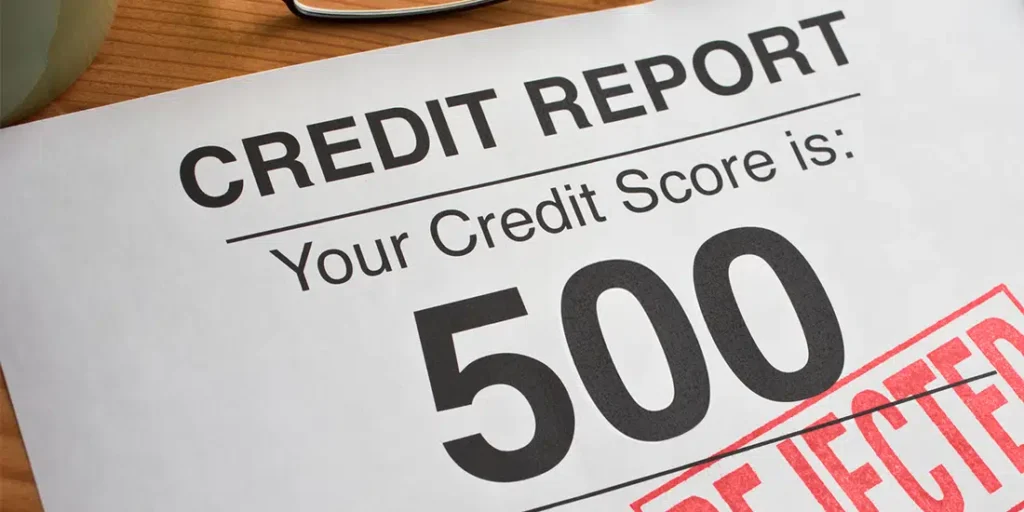
Not all credit cards designed for poor credit are worth having. Some are predatory — loaded with fees that consume your credit limit before you even make a purchase. Here’s what separates a good credit-building card from a trap:
Reports to all three bureaus. This is non-negotiable. A card that only reports to one bureau builds your credit history 3x slower than one that reports to Equifax, Experian, and TransUnion simultaneously. Every card on this list reports to all three.
Low or no annual fee. Some secured cards charge $75–$99/year in annual fees — which on a $200 credit limit consumes 37–50% of your available credit before you spend a dollar. The best credit-building cards charge $0 or under $40/year.
No processing fees that eat your limit. The worst bad-credit cards charge a “program fee” or “processing fee” that immediately reduces your available credit. Avoid these entirely.
A clear path to credit limit increases. The fastest way to lower your utilization (and raise your score) is an increasing credit limit. Look for cards that offer automatic reviews or easy upgrade paths.
Graduation potential. The best secured cards upgrade to unsecured products after 12–18 months of responsible use — returning your deposit and giving you a better card without a hard inquiry.
8 Credit Cards That May Approve You With a 500 Score
1. Discover it® Secured Credit Card
Best overall for credit building at 500
The Discover it Secured is the gold standard for credit-building cards — and it’s one of the few secured cards that makes the process genuinely rewarding.
- Approval: No minimum credit score — accepts applicants with poor or no credit
- Security deposit: $200 minimum, up to $2,500 (becomes your credit limit)
- Annual fee: $0
- Cashback: 2% at gas stations and restaurants (up to $1,000/quarter), 1% everywhere else
- Cashback Match: All Year 1 cashback doubled automatically
- Graduation: Automatic review starting at 7 months — Discover upgrades responsible cardholders to unsecured and returns the deposit
- Reports to: Equifax, Experian, TransUnion
Why it leads: No other secured card on the market offers a first-year Cashback Match on a $0 annual fee product. The automatic graduation review at 7 months means you’re not trapped in a secured card indefinitely. And the 2% on gas and restaurants covers two of the highest everyday spending categories for most Americans.
Best for: Anyone at 500 who can put $200 down and wants the fastest combination of score-building and real rewards.
2. Capital One Platinum Secured Credit Card
Best for low initial deposit
Capital One’s secured card has a feature most competitors don’t: depending on your creditworthiness, you may qualify for a $200 credit limit with a deposit of only $49 or $99 — meaning you get a $200 limit for less than $200 down.
- Approval: Designed for limited or poor credit
- Security deposit: $49, $99, or $200 (all result in $200 initial credit limit)
- Annual fee: $0
- Credit limit increase: Automatic review after 6 months of on-time payments
- Graduation: Capital One reviews accounts and upgrades to unsecured Platinum card
- Reports to: Equifax, Experian, TransUnion
Why it stands out: The tiered deposit structure is the most accessible entry point in the secured card market. If Capital One determines you qualify for the $49 deposit, you’re getting a $200 credit line for less than $50 — an effective 4:1 leverage on your deposit. The 6-month upgrade review is one of the fastest in the industry.
Best for: Applicants with limited cash who need to minimize the upfront deposit while still opening a bureau-reporting account.
3. OpenSky® Secured Visa® Credit Card
Best for applicants with no credit check required
OpenSky is unique among secured cards: it does not run a credit check at all. No hard inquiry, no soft pull, no score requirement of any kind. If you have a valid ID and $200 for a security deposit, you can get this card.
- Approval: No credit check whatsoever — truly open to all
- Security deposit: $200–$3,000
- Annual fee: $35
- Credit limit: Equal to your deposit
- Reports to: Equifax, Experian, TransUnion
- Credit check: None
Why it matters: For applicants who have been denied by every other issuer, or who have active collections or recent derogatory events that make approval unlikely anywhere else, OpenSky removes every barrier except the deposit. The $35 annual fee is the only cost — and against a $200 limit, that’s a 17.5% annual cost, which is worth it if it’s your only avenue to bureau-reporting credit.
Best for: Applicants with very recent negative events (bankruptcy discharge, active collections, multiple recent denials) who need a guaranteed-approval path to start rebuilding.
4. Chime Credit Builder Visa® Secured Card
Best for no deposit, no interest, no fees
The Chime Credit Builder is structurally different from every other card on this list — and for the right person, it’s the most cost-efficient credit-building tool available.
- Approval: No credit check, no minimum credit score
- Security deposit: None — your spending limit is set by the balance you move into your Credit Builder account from your Chime spending account
- Annual fee: $0
- Interest rate: 0% — no APR because it works like a charge card (balance covered by your deposited funds)
- Reports to: Equifax, Experian, TransUnion
- Requirement: Must have a Chime spending account
How it works: You move money from your Chime checking account into a Credit Builder account. That balance becomes your spending limit. When you make purchases and pay them off, Chime reports the activity as credit card payment history. No deposit held separately, no interest charges, no annual fee.
Best for: People already using or willing to use Chime as their primary bank account. The zero-fee, zero-interest structure makes this the lowest-cost credit-building option available — but it requires full integration into the Chime ecosystem.
5. Self Credit Builder Account + Secured Visa®
Best for building credit with no existing card
Self takes a different approach entirely. It starts with a credit-builder loan — you make monthly payments into a savings account, and the payment history is reported to all three bureaus. After you’ve built enough savings balance in the account, you can unlock a secured Visa card using those funds as the deposit.
- Approval: No hard credit check for the credit-builder loan
- Monthly payments: $25–$150/month (your choice)
- Reports to: Equifax, Experian, TransUnion (for both the loan and the card)
- Annual fee (card): $0
- Dual benefit: Builds credit history AND savings simultaneously
Why the dual reporting matters: Most credit-building strategies rely on a single account type (revolving credit from a card). Self adds an installment loan to your profile — which contributes to the “credit mix” factor (10% of FICO score) and diversifies the positive signals you’re sending to the bureaus.
Best for: People at 500 who want to build credit without any upfront deposit, or who want to add installment loan history alongside a revolving card account for faster scoring diversification.
6. Petal® 2 “Cash Back, No Fees” Visa® Credit Card
Best unsecured option for thin-file applicants
The Petal 2 is unsecured — meaning no security deposit required. Petal uses its own underwriting model called “Cash Score™” that evaluates your banking history, income, and spending patterns instead of (or in addition to) your FICO score.
- Approval: No credit history required; uses Cash Score™ underwriting
- Security deposit: None
- Annual fee: $0
- Late fee: $0
- Foreign transaction fee: $0
- Cashback: 1% immediately, up to 1.5% after 12 months of on-time payments, up to 1.5% at select merchants
- Credit limit: $300–$10,000 based on Cash Score™
- Reports to: Equifax, Experian, TransUnion
The catch: Petal 2 approval is not guaranteed for all 500-score applicants. The Cash Score™ underwriting can approve some applicants with poor FICO scores if their banking history is clean — but applicants with recent overdrafts, negative bank balances, or inconsistent income may be declined.
Best for: Applicants with poor FICO scores but clean banking history and documented income — particularly gig workers, recent graduates, and immigrants. For the full breakdown, see our Petal 2 review.
7. Capital One Quicksilver Secured Cash Rewards
Best for earning rewards while rebuilding
Capital One’s secured version of its popular Quicksilver card brings the flat-rate cashback structure to the credit-building tier — a combination that most secured cards don’t offer.
- Approval: Designed for limited/rebuilding credit
- Security deposit: $200 minimum
- Annual fee: $0
- Cashback: 1.5% on every purchase, no categories, no limits
- Foreign transaction fee: $0
- Graduation: Automatic reviews for upgrade to unsecured
Why it belongs here: Most secured cards offer no rewards whatsoever. The Quicksilver Secured earns 1.5% on every purchase from day one — the same flat rate as its unsecured counterpart. For someone using this card for $500/month in everyday spending while rebuilding, that’s $90/year in cashback on top of the credit-building benefit.
Best for: Cardholders who want to earn real rewards during the rebuilding phase without sacrificing approval accessibility. If you’re going to be spending on a credit card anyway, earning 1.5% back while you rebuild costs nothing extra.
8. Applied Bank® Secured Visa® Gold Preferred®
Best for applicants who have been denied everywhere else
Applied Bank’s secured card is one of the most accessible in the market for applicants with severely damaged credit — including recent bankruptcies, multiple collections, or very recent charge-offs.
- Approval: Very accessible — designed for severely damaged credit
- Security deposit: $200–$1,000
- Annual fee: $48 ($4/month)
- APR: Fixed 9.99% — the lowest APR on any secured card available
- Reports to: Equifax, Experian, TransUnion
- Credit check: Soft pull only
The tradeoff: The $48 annual fee is higher than the best options on this list. But the fixed 9.99% APR is genuinely exceptional — most secured and bad-credit cards charge 24–29% APR. For applicants who may occasionally carry a balance during the rebuilding phase, this card’s interest rate advantage can outweigh the annual fee cost.
Best for: Last-resort option for applicants denied by every other issuer, or for rebuilding cardholders who are realistically likely to carry a balance and want to minimize interest costs.
What to Do After You Open Your First Card

Opening the right card is step one. Using it correctly over the next 12 months is what actually moves your score from 500 to 650 — and eventually to 700. For the complete month-by-month roadmap with realistic timelines and every strategy ranked by speed of impact, see our full guide: You Have a 500 Credit Score. Here’s the Exact Roadmap to 700.
Final Thoughts
A 500 credit score is a real obstacle — but it is a temporary one.
Every card on this list was built for exactly where you are right now. Not to trap you there, but to give you a tool that reports to all three bureaus, builds a verifiable payment history, and creates the foundation for everything that comes next.
Pick one card. Use it for one small purchase each month. Pay it down before the statement closes. Repeat for 12 months.
The score moves. The doors open. It’s that straightforward.
For more guides on rebuilding credit, choosing the right first card, and understanding what your score means for your financial life, visit CreditPilotUSA.com — your trusted co-pilot for navigating the world of credit.
Disclaimer: Approval is not guaranteed and depends on individual credit profiles and issuer criteria at the time of application. Card terms, fees, and features are subject to change. Always verify current offers directly with each issuer before applying. This article is for educational purposes only.

Danilo is a Credit Analyst and the Founder of CreditPilotUSA.com. With deep expertise in the credit card industry, he translates complex banking news and reward systems into actionable financial strategies. Dedicated to helping Americans master their credit scores and maximize the cards in their wallets.