
Short answer: If your card has a grace period and you pay in full each month, paying the statement balance by the due date is generally what avoids interest on purchases. Paying the current balance is also fine, and it also pays off charges that haven’t been billed yet. If you already carry a balance from earlier months, paying only the statement balance may not be enough to stop interest. Check your card agreement.
The two balances
- Statement balance: What you owed when your billing cycle closed. It includes carried-over balances, fees and interest, minus payments and credits. Citi explains that it stays fixed until the next cycle, even if you keep spending.
- Current balance: What you owe right now. Citi describes it as including posted charges, payments, credits, interest and fees since the last statement. Experian says it can also reflect pending activity. Issuers differ on how they treat pending transactions, so check how yours labels it.
Your statement balance is set on your closing date, and it is due on a later date. See credit card closing date vs. due date for how those dates work.
A hypothetical bill
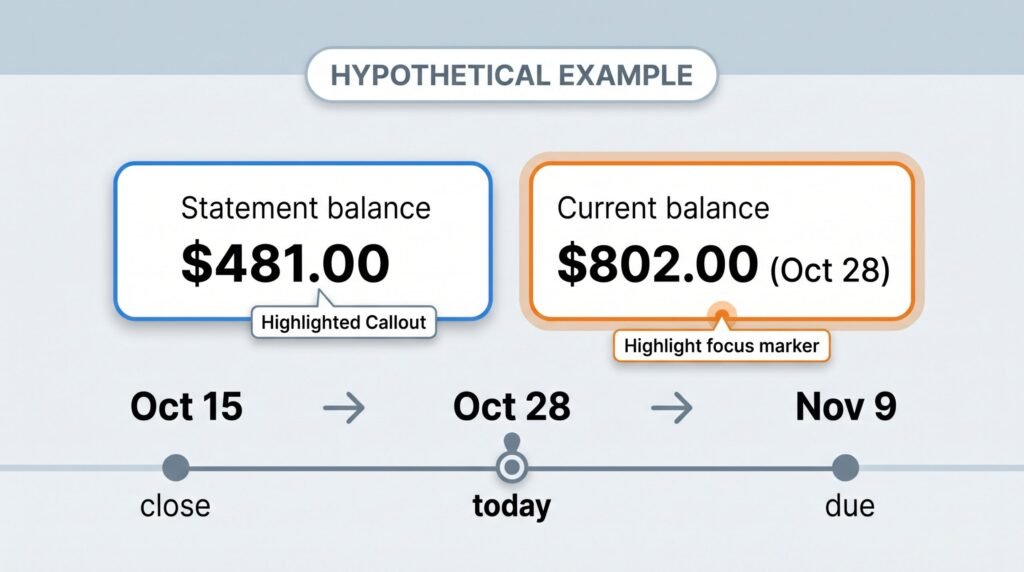
Everything below is invented for illustration. These are not real rates, accounts or issuer terms.
Hypothetical statement: cycle Sep 16 – Oct 15, due date Nov 9, credit limit $2,000, previous balance $0.00
| Date | Description | Amount |
|---|---|---|
| Sep 18 | Grocery | $142.60 |
| Sep 22 | Gas | $48.30 |
| Sep 27 | Online order | $219.99 |
| Oct 3 | Restaurant | $67.45 |
| Oct 9 | Streaming | $15.99 |
| Oct 12 | Pharmacy | $31.17 |
| Oct 14 | Return credit | −$44.50 |
| Statement balance | $481.00 | |
| Minimum payment (hypothetical) | $35.00 |
The statement closed on Oct 15 and the due date is Nov 9, a gap of 25 days. After the close, you keep using the card:
| Date | Description | Amount |
|---|---|---|
| Oct 18 | Grocery | $96.20 |
| Oct 21 | Gas | $52.80 |
| Oct 25 | Online order | $128.00 |
| Oct 27 | Restaurant | $44.00 |
| New charges since close | $321.00 |
On Oct 28, your app shows a current balance of $802.00 ($481.00 + $321.00), while the statement still says $481.00. Both numbers are correct. They answer different questions.
What each payment does on Nov 9
Assumptions: your card has a grace period on purchases, you paid in full the previous month, and you make no further purchases.
| You pay | Still owed after paying | Result |
|---|---|---|
| $802.00 (current balance) | $0.00 | No interest on purchases. The card is fully paid off, which frees up available credit. |
| $481.00 (statement balance) | $321.00 (appears on your next statement) | No interest on the billed purchases. The $321 gets its own grace period on the next statement. |
| $35.00 (minimum) | $446.00 of the statement balance ($481.00 − $35.00) | You avoid a late fee but lose the interest-free window. See below. |
For the minimum-payment case, take a hypothetical 24% APR and a simplified monthly rate of 2% (24% ÷ 12). The unpaid $446.00 would cost roughly $8.92 for one month ($446.00 × 0.02). That ignores interest on new purchases, which the CFPB says starts on each purchase date once you lose the grace period. Real issuers calculate interest in their own ways, so treat this as a rough illustration, not a prediction.
Why the statement balance is the usual target
A grace period is the gap between the end of your billing cycle and your due date. Per the CFPB:
- Issuers aren’t required to offer one, though most cards give one on purchases.
- You generally avoid interest on new purchases if you pay the balance in full by the due date.
- If you don’t pay in full, you’re charged interest on the unpaid portion.
- Paying in full some months and not others can cost you the grace period for that month and the next.
Federal law also requires issuers to deliver statements at least 21 days before the due date. See 15 U.S.C. § 1666b, which also ties any interest-free grace period to that 21-day timing.
When paying the current balance makes more sense
- You want a zero balance: Experian notes this can free up available credit before a large purchase.
- You already carry a balance: Citi says paying the current balance can generally stop further interest, but you should check whether new purchases would be charged interest immediately.
- You’re about to apply for credit: A lower reported balance may help, as explained below.
The credit-score angle
Issuers generally report balances to the credit bureaus about once a month, often shortly after the cycle ends. Experian says the reported balance may be the same as or similar to the statement balance, and that you can have a high utilization ratio even if you pay the statement balance in full. Exact timing varies, and you can ask your issuer when it reports.
In our hypothetical, $481.00 on a $2,000 limit is 24.05% utilization. If you had instead paid $300 on Oct 14, before the close, the statement balance would have been $181.00, or 9.05%. You would then owe only $181.00 by Nov 9. Paying after the close doesn’t change what that statement already reported. This is an illustration, and your issuer’s reporting may differ.
Exceptions and risks
- No grace period: Some cards, or some balances, don’t have one. Look in your card agreement for how interest on purchases is handled.
- Cash advances and balance transfers: The CFPB says grace periods typically apply only to purchases. Cash advances generally start accruing interest on the transaction date.
- Promotional balances: Carrying a promotional-rate balance can change how your grace period works. Read your offer terms.
- Pending transactions: They may lower your available credit even if they’re not in the current balance, per Experian.
- Late payments: Missing the minimum can mean fees. Citi notes a payment 30 or more days late can be reported to the credit bureaus.
- Paying between the two: Any amount at least equal to the statement balance keeps interest off billed purchases. Amounts below it usually don’t.
Practical next steps
- Find your statement closing date and due date in your app. They’re different dates.
- Compare your statement balance with your current balance.
- If you pay in full monthly, pay at least the statement balance by the due date. Turning on autopay for the statement balance is one way to do this.
- If you carry a balance, read your card agreement on how interest accrues, then consider paying the current balance or as much as you can.
- If a credit application is coming, ask your issuer when it reports balances. Consider paying before the statement closes.
- Always pay at least the minimum on time, even if you pay nothing else.
FAQ
Is the statement balance always lower than the current balance? No. If you’ve paid or received credits since the statement, the current balance can be lower. If you’ve spent more, it’s higher.
If I pay the current balance, do I still owe the statement balance? Generally no. Paying the current balance covers both the billed charges and the new charges. Confirm in your account that the statement balance shows as paid.
Does paying early hurt me? Nothing in the sources reviewed says it does. Paying before the due date is fine as long as the payment posts and covers what you intend.
This article is educational and not financial or legal advice. Card terms vary by issuer and account, so check your agreement.
4. Fact-checking table (verified 28 Oct 2026)
| Claim | Source | URL | Notes |
|---|---|---|---|
| Grace period = gap between cycle end and due date; not required; most cards give one on purchases | CFPB | https://www.consumerfinance.gov/ask-cfpb/what-is-a-grace-period-for-a-credit-card-en-47/ | Page last reviewed Sep 23, 2024. Fetched. |
| Pay in full by due date to avoid interest on new purchases; lost grace period means interest on unpaid portion and on purchases from purchase date | CFPB | same | Fetched. |
| Skipping full payment can lose the grace period for that month and the next | CFPB | same | Fetched. |
| Grace periods typically apply only to purchases; cash advances accrue from transaction date | CFPB | same | Fetched. |
| Statements must be delivered at least 21 days before due date; interest-free grace period tied to that timing | 15 U.S.C. § 1666b | https://www.law.cornell.edu/uscode/text/15/1666b | Fetched. The page doesn’t state its own currency date. Confirm against the eCFR or US Code release point. |
| Statement balance definition; example; stays fixed until next cycle | Citi | https://www.citi.com/credit-cards/understanding-credit-cards/statement-balance-vs-current-balance | Page dated Oct 3, 2025. Fetched. Issuer content. |
| Current balance definition (posted items); options for paying; carrying balances; 30+ days late reportable | Citi | same | Fetched. |
| Current balance can include pending activity; pending items may reduce available credit | Experian | https://www.experian.com/blogs/ask-experian/current-balance-vs-statement-balance/ | Dated Aug 6, 2026. Fetched. Bureau content. The page is internally ambiguous on pending items. |
| Issuers report monthly, often after the cycle ends; reported balance may be similar to the statement balance; high utilization possible even if paid in full | Experian | same | Fetched. Timing varies and isn’t verified for any specific issuer. |
| Pay current balance to free available credit | Experian | same | Fetched. |
| All hypothetical figures ($481.00, $321.00, $802.00, 24.05%, 9.05%, $446.00, $8.92, 25 days) | Internal calculation | n/a | Arithmetic re-checked. The 24% APR and $35 minimum are invented for illustration. |

Danilo is a credit analyst and the founder of CreditPilotUSA.com. He writes about credit cards, personal loans, and credit scores for U.S. consumers, turning complex financial topics into clear, practical explanations. His focus is helping readers understand borrowing costs, compare options, and make informed decisions about building credit and managing debt.